
Why are telehealth companies quietly adding camera-based vitals to their platforms?
Why telehealth companies are quietly adding camera vitals: a research-backed look at workflow, reimbursement, access, and white-label platform economics.
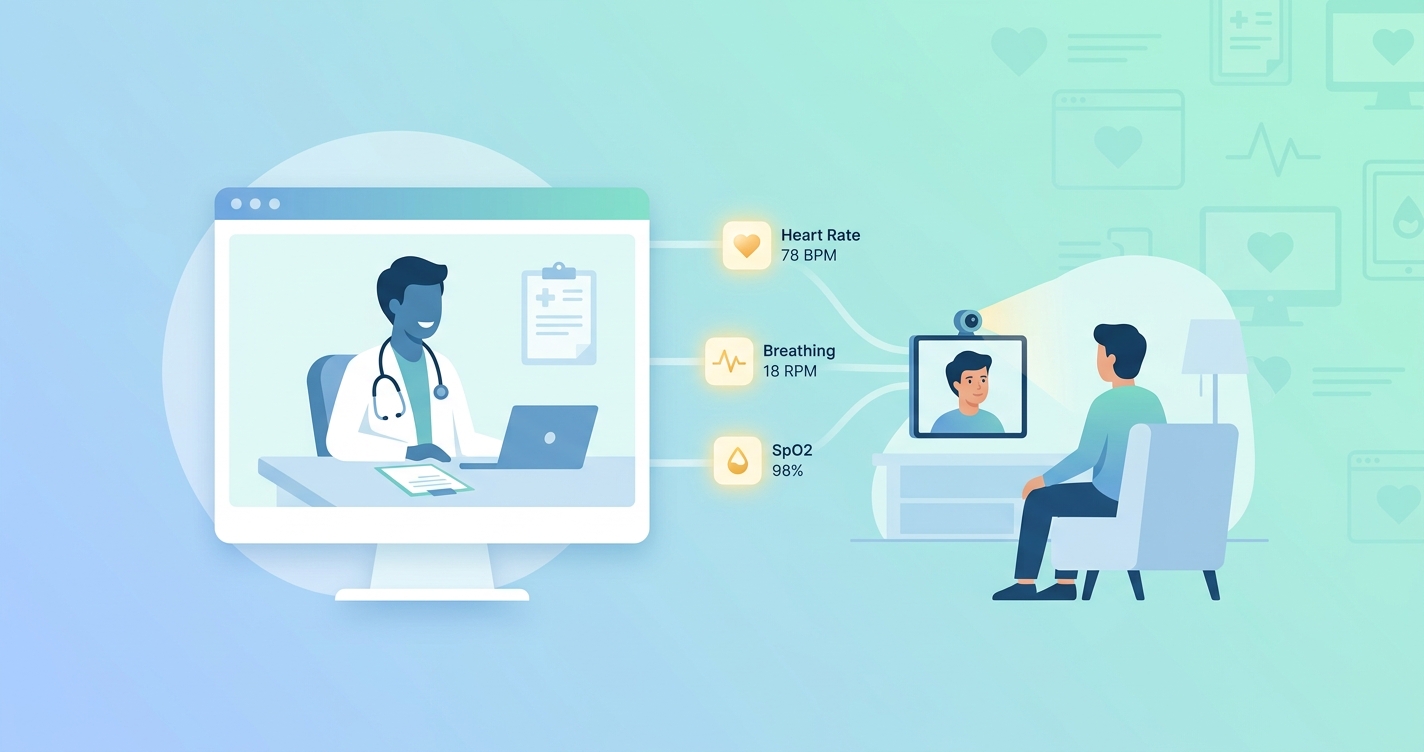
When founders ask why telehealth adding camera vitals has become such a quiet but persistent trend, the short answer is that virtual care is no longer judged only on video quality or scheduling convenience. Buyers now want a telehealth platform to close at least part of the data gap that still exists between remote and in-person encounters. Camera-based vitals are attractive because they add physiological signals without forcing a company to ship hardware, redesign the visit around Bluetooth troubleshooting, or wait a year for an internal sensing stack to mature. That is a pretty compelling combination if you run product, partnerships, or hospital IT.
"Patient-facing telehealth use in 2024 is significantly higher than pre-pandemic levels" at 71.4% of physicians, while remote patient monitoring reached 20.3%, according to the American Medical Association's 2024 Physician Practice Benchmark reporting.
Telehealth adding camera vitals: what is actually driving the shift?
There is a temptation to frame camera-based vitals as a flashy AI feature. I think that misses what is really happening. Most telehealth teams are acting for fairly boring reasons, and boring reasons are usually the real ones.
McKinsey reported that more than 50 million in-person visits per year could shift to virtual care if adoption became more equitable across patient segments. That matters because access alone is not enough anymore. Virtual care has to feel clinically useful. At the same time, the AMA found that telehealth remained embedded in practice patterns in 2024, with videoconferencing at 63.2% of physicians and remote patient monitoring adoption roughly doubling from 2018 to 2024.
Once those two realities collide, product teams start asking a more practical question: if virtual care is staying, how do we make each encounter more informative without adding friction?
| Strategic pressure | Why telehealth companies care | Why camera-based vitals fits |
|---|---|---|
| Visit quality pressure | Clinicians want more than self-reported symptoms during remote visits | Adds objective signals during or before the encounter |
| Access pressure | Virtual care needs to work for broader patient populations | Uses existing smartphone, tablet, or laptop cameras |
| RPM and monitoring pressure | More organizations want ongoing physiological data, not just video visits | Extends virtual care into light-touch monitoring workflows |
| Build-vs-buy pressure | Few teams want a long in-house computer-vision program | White-label or embedded models shorten time to market |
| Workflow pressure | Hospitals and digital health startups want fewer peripherals and fewer support tickets | Avoids shipping and pairing dedicated devices in many use cases |
That table is the real story. Camera-based vitals are not being added because every telehealth company suddenly wants to become a sensing lab. They are being added because the feature answers several business problems at once.
The quiet economics behind camera-based vitals adoption
This is where the trend makes more sense. Telehealth companies do not always announce these moves loudly because the decision often looks more operational than brand-defining. It sits somewhere between workflow design, reimbursement logic, and product defensibility.
The 2022 Journal of Medical Internet Research systematic review on telehealth business models examined 4,998 records and included 23 studies. The authors concluded that value proposition, financial variables, and revenue streams are core business-model components in telehealth. That sounds abstract, but it maps cleanly to this market. A platform that can add a vitals layer without major hardware costs changes both the product story and the unit economics.
A few things happen at once:
- the visit becomes easier to position as a fuller care interaction
- follow-up monitoring options expand without creating a device logistics program
- a white-label platform can launch faster than a deep internal build
- enterprise buyers get a more differentiated feature set in demos and pilots
- operators avoid some of the support burden that comes with peripherals
I would not call this glamorous. I would call it rational.
Why camera-based vitals are more attractive now than they were a few years ago
The technology itself has matured enough to be taken seriously in telehealth roadmap conversations. That does not mean every implementation is equal, and it definitely does not mean every claim in the market should be trusted. But the research base is large enough now that serious buyers no longer treat remote photoplethysmography as a science-fair demo.
A 2024 review in Frontiers in Imaging on remote photoplethysmography for health assessment described rPPG as a contactless method that can extract physiological signals from ordinary video using ambient light and skin-tone variation. Another 2024 review indexed in PubMed, focused on deep learning and rPPG-powered contactless physiological measurement, summarized 145 articles and reported that deep learning methods were improving robustness in real-world conditions, especially around motion and lighting challenges.
That matters for telehealth because production teams do not need perfection in every edge case to find the feature useful. They need a credible signal pathway, usable workflows, and a deployment model that can survive real product constraints.
Industry applications
Digital health startups trying to add depth without slowing launch
For early and growth-stage telehealth companies, camera-based vitals are often a speed play. A founder may want a stronger clinical story, better activation during onboarding, or a clearer bridge into remote monitoring, but may not want to fund a long internal computer-vision program. A white-label layer is appealing because it preserves product focus.
In practice, that means a startup can test whether users and clinicians actually engage with pre-visit or in-visit vitals capture before committing to a much larger platform rewrite. That is a much more founder-like decision than pretending the only respectable path is to build everything from scratch.
Telehealth platform PMs trying to improve workflow quality
Platform teams often sit between clinical expectations and engineering reality. They hear the same objections over and over: virtual visits rely too much on self-report, clinicians want more context, and patients drop off when setup gets annoying.
Camera-based vitals can help because the workflow is lightweight:
- open the existing device camera
- complete a short scan
- route results into the visit or dashboard
- keep the experience under the telehealth brand
That is a cleaner workflow than mailing hardware for every light-touch use case. It is also easier to pilot with specific programs before rolling out more broadly.
Hospital IT and innovation teams reducing peripheral complexity
Hospital-owned practices already show higher telehealth and remote patient monitoring use than private practices, according to the AMA data. That is important because health systems tend to push harder on integration, governance, and scalability.
For these buyers, camera-based vitals are not just about novelty. They can be a way to reduce parts of the peripheral-management headache in use cases where contactless capture is operationally acceptable. Less device procurement, less pairing support, fewer shipping loops. Nobody throws a parade for that, but it is exactly the kind of thing large organizations will pay attention to.
Current research and evidence
The evidence behind adoption is a mix of market behavior, workflow reality, and technical progress.
McKinsey's work on virtual care access argued that more than 50 million in-person visits annually could become virtual if access barriers were addressed more evenly. That signals continuing platform demand, not a temporary pandemic leftover. The AMA's 2024 physician survey adds a second layer: telehealth use is still structurally elevated, and remote patient monitoring use has expanded alongside it.
On the technology side, the 2024 Frontiers in Imaging review described rPPG as a low-cost, contactless monitoring method with obvious relevance for remote healthcare. The 2024 PubMed-indexed review on deep learning and rPPG highlighted that contactless physiological measurement has strong prospects in telehealth and remote care, while also noting that model robustness and standardization still matter. I actually like that mix of optimism and restraint. It sounds like real infrastructure work, not marketing poetry.
| Source | Key finding | Why it matters here |
|---|---|---|
| AMA Physician Practice Benchmark Survey / AMA analysis (2024) | 71.4% of physicians used telehealth in 2024; RPM use reached 20.3% | Telehealth is still mainstream enough that platforms now compete on depth, not just availability |
| McKinsey on virtual care access | More than 50 million in-person visits could shift to virtual if adoption barriers were reduced | Virtual care still has room to expand, increasing demand for richer remote workflows |
| JMIR systematic review (2022) | Review of 4,998 records and 23 included studies found value proposition and revenue structure central to telehealth business models | Camera-based vitals can change both the product story and the business model logic |
| Frontiers in Imaging review (2024) | rPPG offers contactless physiological monitoring using ordinary video and ambient light | The sensing approach matches telehealth's low-friction delivery model |
| PubMed-indexed deep-learning rPPG review (2024) | Review of 145 articles found improving accuracy and robustness for contactless measurement | The technical foundation is maturing enough for commercial deployment discussions |
The future of telehealth adding camera vitals
I do not think every telehealth platform will add camera-based vitals. Some care models do not need it. Some clinical programs will still prefer dedicated devices. Some buyers will decide the workflow gain is not worth the implementation effort.
But I do think the category is moving from "interesting feature" toward "reasonable expectation" in a growing slice of the market.
Three patterns point that way:
- telehealth is settling into normal practice rather than emergency substitution
- remote monitoring is becoming a more familiar operating model for physicians and health systems
- contactless sensing fits the long-term pressure to reduce friction in home-based care
The quieter point is probably the biggest one: camera-based vitals let companies make virtual care feel more substantive without asking patients to become amateur IT technicians. That alone explains a lot.
Frequently asked questions
Why are telehealth companies adding camera-based vitals now?
Because telehealth is no longer new enough to compete on video access alone. Platforms want more clinical context, broader monitoring options, and a better product story without the overhead of device-based deployment in every use case.
Do camera-based vitals replace all remote monitoring devices?
No. Many programs will still use connected peripherals, especially for conditions that require dedicated measurement tools or more formal longitudinal monitoring. Camera-based vitals are better understood as a lower-friction option for selected workflows.
Why are companies doing this quietly instead of making a big announcement?
Often because the decision is operational. It improves workflow, differentiation, and implementation economics, but it may not be the kind of product launch a company wants to headline until the integration is proven.
Are white-label deployment models part of the reason?
Yes. White-label and embedded deployment models let telehealth companies test or launch camera-based vitals faster than a deep in-house build, while keeping the experience under their own brand.
If your team is comparing how to add branded contactless vitals into an existing virtual-care stack, Circadify Custom Builds is built for teams that want white-label flexibility without standing up the sensing layer from scratch.
Related reading on this site: How Telehealth Platforms Add Vitals Without Building In-House, White-Label vs. Build From Scratch: Health Monitoring Platform Tradeoffs, and 7 Integration Points When Connecting a White-Label Platform to Your EHR.