
White-Label Health Tech for Clinical Trials and Research Apps
How research sponsors capture white label vitals for clinical trials under their own brand, without device shipping or hardware logistics.
Clinical research has quietly become a software problem. The protocols still matter, the endpoints still matter, but the operational cost that decides whether a study finishes on time now sits in logistics: shipping devices, training participants, chasing missing measurements, and reconciling data that arrives in six different formats. For sponsors and the platform teams who build research apps, white label vitals for clinical trials has turned into a practical answer to that cost, because it lets a study collect heart rate, respiration, and other physiological signals through software the participant already owns, presented under the sponsor's own brand. The appeal is not novelty. It is the removal of a hardware supply chain from the critical path of enrolling and retaining patients.
Retention rates in decentralized or hybrid trials have been reported between 89% and 97%, compared with 60% to 70% in traditional site-based studies, a gap that directly affects statistical power and trial timelines.
This shift is happening against a fast-growing market. Industry analysts including Medi-Tech Insights and Global Market Insights estimate the global decentralized clinical trials market at roughly 8.8 to 9.9 billion dollars in 2025, with forecasts reaching 28 to 38 billion dollars by 2035 at compound annual growth rates between 13.7 and 20 percent. Regulatory direction caught up in September 2024, when the U.S. Food and Drug Administration finalized its guidance on Conducting Clinical Trials with Decentralized Elements, giving sponsors a clearer framework for collecting data outside the traditional site.
Why white label vitals for clinical trials changes the operating model
A decentralized or hybrid trial moves measurement from the clinic to wherever the participant is. The traditional way to do that is to mail a kit of connected sensors, oximeters, blood pressure cuffs, and a study phone. That works, but it creates a parallel operation: procurement, calibration, inventory, returns, and replacement for lost or broken units. Every device is a point of failure and a help-desk ticket.
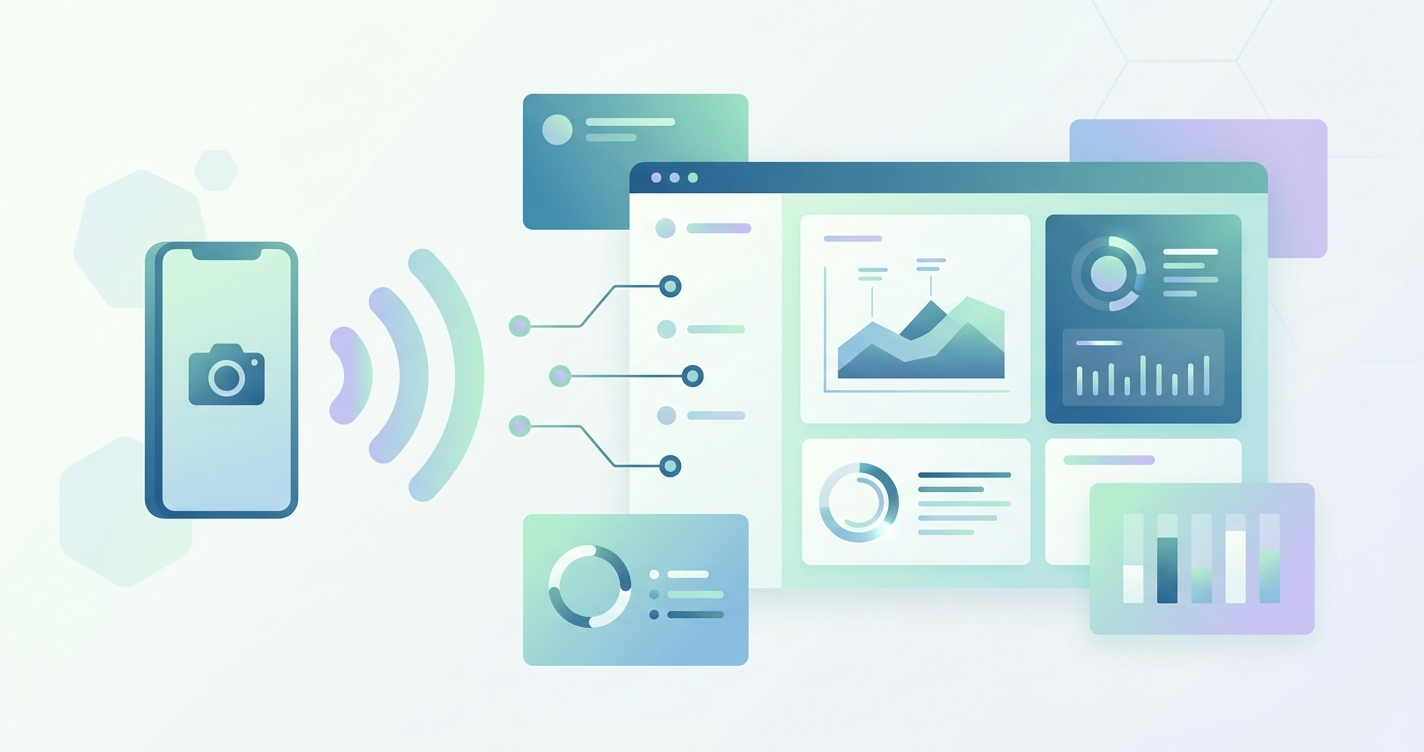
A white label vitals approach replaces some of that kit with camera-based remote photoplethysmography (rPPG), which reads physiological signals from a short video of the participant's face captured on a standard smartphone or tablet. Because the sensor is the camera, there is no device to ship and nothing to return at study close. The capture experience carries the sponsor's or research app's branding, so participants interact with a tool that looks like part of the study rather than a third-party gadget. For a branded research monitoring tool, that consistency reduces confusion and the support burden that drives dropout.
The strategic point for a platform PM is ownership. A white-labeled engine means the sponsor controls the participant relationship, the data schema, and the brand, while the underlying signal processing is licensed rather than built. That separation lets a life sciences team add decentralized trial vitals to an existing eConsent and ePRO stack without standing up a hardware division.
| Capture approach | Hardware logistics | Branding control | Data standardization | Best fit |
|---|---|---|---|---|
| Mailed device kits | High: shipping, returns, calibration | Limited, vendor-branded devices | Variable across device makers | Trials needing regulated diagnostic devices |
| Bring-your-own wearables | Low shipping, high variability | Minimal, consumer brand visible | Fragmented by model and firmware | Long-term continuous signals |
| White-label rPPG app | None: uses participant phone | Full sponsor branding | Single schema, one pipeline | Scheduled spot checks across diverse cohorts |
| Site-only measurement | None remote, all on-site | Full, but no remote reach | High but low frequency | Small early-phase studies |
The table simplifies real decisions, but it captures the trade most teams weigh: diagnostic precision and continuous data on one side, against reach, cost, and operational simplicity on the other. Many protocols end up hybrid, reserving validated devices for primary endpoints and using software capture for frequent contextual readings.
Key operational advantages sponsors report from software-based capture include:
- No outbound or return shipping, which removes a recurring per-participant cost and a customs barrier for multi-country studies.
- A single data pipeline instead of reconciling exports from several device vendors.
- Faster onboarding, since participants use a phone they already know how to operate.
- Wider eligibility, because the approach does not exclude participants who struggle with unfamiliar hardware.
- Brand continuity that keeps the study experience coherent from consent through follow-up.
Industry applications for branded research monitoring
Sponsor-run decentralized trials
Pharmaceutical and biotech sponsors running decentralized or hybrid protocols use white-labeled capture to gather scheduled vitals between visits. The data flows into the sponsor's electronic data capture system under a defined schema, supporting both safety monitoring and contextual covariates. Because retention is the metric that most often sinks a trial, reducing participant friction has a direct line to budget and timeline.
Research platform and SaaS builders
Companies that sell software to sponsors and contract research organizations embed a remote patient data collection capability so their platform can offer vitals capture as a native feature rather than a referral to a hardware partner. White-labeling lets the platform present the function as its own, protecting the brand and the customer relationship.
Academic and registry studies
University groups and disease registries operate on tighter budgets than industry sponsors and rarely have the capital to buy and manage device fleets. A health data capture platform that runs on participant phones lets these studies reach larger and more geographically diverse cohorts without a logistics team, which matters for studies aiming at representative enrollment.
Post-market and real-world evidence
After approval, manufacturers and payers run real-world evidence studies that benefit from frequent, low-burden measurement across large populations. Software capture scales to those numbers in a way that device shipping does not.
Current research and evidence
The evidence base supporting decentralized measurement has grown alongside regulatory acceptance. The FDA's September 2024 final guidance on decentralized elements signaled that remote data collection, when properly validated and governed, is an acceptable part of trial design rather than an exception. That clarity has lowered the perceived regulatory risk for sponsors evaluating remote vitals.
On retention, work such as the COVID-RED trial documented in peer-reviewed literature in PMC has examined what keeps participants engaged in large-scale decentralized studies, pointing to reduced travel burden and simpler technology as recurring factors. The retention spread that analysts cite, 89 to 97 percent for decentralized and hybrid designs versus 60 to 70 percent for site-based studies, is the headline number sponsors use to justify the operating model, though real results depend heavily on protocol complexity and participant support.
Infrastructure data tells a parallel story. Analysts report that cloud platforms captured more than 55 percent of the decentralized clinical trials market in 2025, reflecting how much of this work now runs on shared, multi-stakeholder software rather than bespoke systems. That is the environment a white-label engine is designed to slot into. The open research question for camera-based vitals specifically remains measurement agreement across skin tones, lighting, and motion, which is why most sponsors treat software readings as supportive data and reserve validated devices for primary endpoints.
The future of remote vitals in clinical research
Several trends point toward broader use. Protocol designs are increasingly hybrid by default, mixing on-site visits for procedures that require them with remote capture for everything else. As that becomes standard, the question for sponsors stops being whether to collect remote vitals and becomes which signals to collect remotely and through what brand.
Three developments are worth watching:
- Tighter integration between capture tools and electronic data capture systems, so remote vitals arrive in audit-ready form without manual reconciliation.
- Wider regulatory harmonization beyond the United States, as other agencies issue their own decentralized trial frameworks.
- Growing scrutiny of measurement equity, pushing vendors to publish performance across diverse populations rather than aggregate accuracy alone.
For platform teams, the durable advantage is architectural. A study or product that owns its participant experience and data layer, while licensing the signal engine, can adapt as protocols and rules evolve without rebuilding from scratch.
Frequently asked questions
What does white label vitals for clinical trials actually mean? It refers to licensing a vitals-capture engine that a sponsor or research platform presents under its own brand. Participants see the study's name and design, while the underlying measurement technology is supplied by a vendor and runs invisibly behind that branding.
Can software capture replace validated medical devices in a trial? Usually not for primary endpoints. Most sponsors use software-based readings as supportive or contextual data collected frequently between visits, and reserve regulator-recognized devices for the measurements that drive the study's core conclusions.
How does removing device kits affect retention? It removes a major source of participant friction: setup, troubleshooting, and returns. Since travel and technology burden are among the top reasons participants leave studies, lowering that burden is one factor behind the higher retention reported in decentralized designs.
Does the 2024 FDA guidance permit remote vitals collection? The FDA's September 2024 final guidance on conducting trials with decentralized elements provides a framework for collecting data remotely when methods are validated and properly governed. It does not endorse any specific product, so sponsors remain responsible for demonstrating fitness for their protocol.
Circadify is building toward this space, supplying a fully white-labeled contactless vitals engine that research sponsors and life sciences platform teams can deploy under their own brand without managing a hardware supply chain. Teams evaluating decentralized capture for an upcoming protocol or product roadmap can explore a partnership and request a demo at circadify.com/custom-builds.