
White-Label Health Platform Revenue Models: How to Monetize
A research-backed analysis of white-label health platform revenue models, covering subscription, licensing, reimbursement, and channel strategies for digital health operators in 2026.
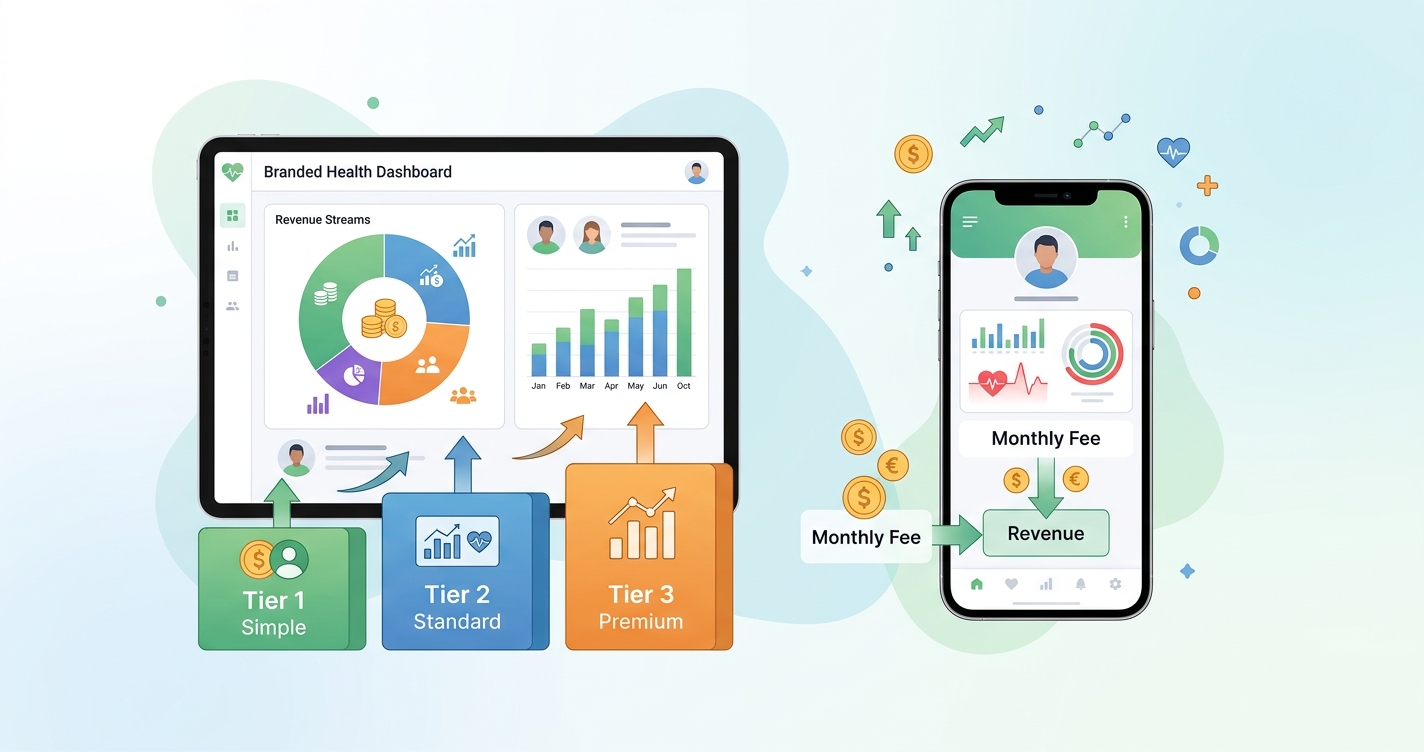
Most white-label health platforms do not fail because the technology is weak. They fail because the revenue design is fuzzy. Buyers may love the speed of launch, the branded UX, and the promise of a turnkey platform, but that does not automatically answer the harder question: who pays, on what basis, and how margins hold up once the first pilot turns into a real operating business? In 2026, that is the central commercialization question behind the white label health platform revenue model monetize debate.
"Workable telemedicine reimbursement is a critical enabling factor in expanding health care access by incentivizing provider participation, ensuring financial sustainability, promoting equity in access, and aligning telemedicine with broader health goals." — Evan Huang-Ku and colleagues, Health Intervention and Technology Assessment Program Foundation and University of Toronto, Journal of Medical Internet Research (2025)
White-Label Health Platform Revenue Model Monetize: The Core Models
A white-label health platform usually sits between infrastructure software and care delivery. That means the revenue model can come from software economics, healthcare reimbursement, or a hybrid of both. The best operators do not treat monetization as a single lever. They stack several of them.
In practice, four revenue models show up most often.
| Revenue Model | How Revenue Is Earned | Margin Profile | Operational Complexity | Best Fit | Main Risk |
|---|---|---|---|---|---|
| Platform subscription | Recurring monthly or annual fee for branded platform access | High once implementation costs are absorbed | Low to moderate | Digital health startups, employer wellness vendors, virtual care platforms | Churn if usage stays shallow |
| Per-member or per-patient pricing | Fee tied to enrolled lives, active users, or monitored patients | Strong if support is automated | Moderate | RPM programs, payer pilots, population health programs | Margin pressure if engagement falls |
| License + implementation | Upfront setup fee plus annual software license | Attractive early cash flow | Moderate | Hospital systems, enterprise buyers, regional deployments | Revenue can become lumpy |
| Revenue-share or reimbursement-linked | Share of claims revenue, care management revenue, or downstream program income | Potentially high but variable | High | Telehealth, RPM, chronic care, value-based care | Dependent on policy, workflows, and collections |
That mix matters because digital health markets are getting larger, but they are also getting more demanding. Grand View Research estimated the global digital health market at $288.55 billion in 2024 and projected it to reach $946.04 billion by 2030. Bigger markets usually attract more buyers, but they also attract buyers who want cleaner unit economics and faster proof of ROI.
Subscription Revenue Still Anchors the Category
The most common starting point for a white-label platform is still a software subscription. Buyers pay for access to the branded portal, administrative controls, workflow configuration, reporting, and support. This model remains attractive because it is easy to budget and easy for finance teams to understand.
The catch is that subscription-only pricing can underprice the platform if customer usage expands quickly. A startup may sign with 2,000 users in mind and then push toward 50,000 once distribution works. If the pricing model never anticipated that growth, support and cloud costs start eating the margin.
That is why many mature white-label vendors now use a two-part structure:
- A base platform fee for access, branding, and admin tooling
- A variable usage fee tied to active members, readings, or workflow volume
- Optional implementation fees for integrations, training, and custom dashboards
I keep coming back to this point because it separates a software product from a real platform business. A platform that is central to care delivery rarely stays a flat-fee product for long.
Per-Patient Economics Work Best When the Workflow Is Already Defined
Per-patient pricing makes the most sense when the buyer already knows the care model. A health system rolling out a branded remote monitoring service, for example, may prefer pricing based on active monitored patients rather than named software seats.
This has become more important as reimbursement models mature. In their 2025 JMIR scoping review, Evan Huang-Ku, Panchanok Muenkaew, Kinanti Khansa Chavarina, and colleagues found that telemedicine payment approaches now span fee-for-service, capitation, bundled payment, and value-based structures. That matters for white-label operators because reimbursement no longer flows through one clean lane. The platform has to fit the economics of the program using it.
A per-patient model usually works when:
- The customer has a measurable enrollment base
- Activation and adherence can be tracked cleanly
- Customer success teams can influence engagement
- The platform sits inside a billable or budgeted care program
If those conditions are missing, per-patient pricing can look elegant in the sales deck and messy in the P&L.
Where Revenue Really Comes From in 2026
White-label health platform monetization is no longer just about charging for software. The strongest operators map their revenue stream to the customer's business model.
Monetization Path Comparison
| Buyer Type | Typical White-Label Offer | Most Common Revenue Logic | What Buyers Actually Want |
|---|---|---|---|
| Digital health startup | Fast branded launch with low engineering lift | Subscription + implementation | Faster go-to-market and investor-ready traction |
| Telehealth platform | Branded vitals, intake, or monitoring workflows | PMPM, visit-linked pricing, or revenue share | Monetization tied to patient throughput |
| Hospital system | Dedicated instance with custom workflows and reporting | Annual license + services + integration fees | Predictable budget and procurement clarity |
| Payer or benefits operator | Member-facing portal with analytics and segmentation | Per-member pricing + setup + optional outcomes incentives | Population-scale economics and reporting |
| RPM provider / care manager | Branded monitoring workflow under existing care operations | Per-patient pricing or reimbursement-linked share | Gross margin after labor, outreach, and claims overhead |
Rock Health's 2025 year-end funding overview captured the backdrop. U.S. digital health startups raised $14.2 billion in 2025, up 35% from 2024, but fewer companies captured that capital and average deal size climbed to $29.3 million. In plain English: investors still fund digital health, but they are increasingly funding businesses that look like infrastructure, not experiments. White-label platforms fit that mood when their pricing is disciplined.
Revenue Share Can Work, but Only in Narrow Cases
Revenue-share models sound appealing because they align incentives. The white-label platform earns more only when the customer earns more. In reality, they only work well when the care workflow, reimbursement codes, collections process, and patient engagement model are already mature.
That caution is backed by published research. A 2025 Health Affairs analysis found that primary care practices adopting remote physiologic monitoring increased Medicare revenue by 20.0% relative to matched nonadopters. But the fact that RPM can expand revenue at the practice level does not mean every technology vendor should price on pure upside. Claims delays, staffing gaps, and uneven patient adherence can turn a theoretically attractive revenue-share deal into a long collection cycle.
For most white-label health companies, revenue share is strongest as an add-on rather than the whole contract. A sensible structure might be:
- Platform minimum fee to protect base economics
- Variable fee tied to active use or monitored patients
- Bonus or shared upside when specific program thresholds are met
That setup preserves alignment without turning the vendor into an unpaid operator.
Current Research and Evidence
The research base around digital monitoring and platform economics points in one direction: monetization improves when the platform is tightly integrated into real care delivery.
Anne-Jet Jansen, Guido Peters, Laura Kooij, and Carine Doggen reported in npj Digital Medicine (2025) that 72% of included studies in their systematic review showed a decrease in at least some aspects of hospital service use when device-based remote monitoring was used. Their larger point was just as important as the headline number. Technology alone was not enough; workflow integration, patient support, and clinical process design shaped the outcome.
That finding lines up with the revenue side of the market. If a white-label platform sits outside the buyer's operating workflow, it is hard to defend premium pricing. If it becomes part of triage, scheduling, monitoring, or outreach, the economics get stronger because the platform starts affecting throughput, staffing, and reimbursement.
A separate study on hospital finances found a more nuanced picture. In "Early adoption of telehealth/remote patient monitoring and hospital revenue changes during COVID-19," researchers studying 1,742 U.S. hospitals found that pre-pandemic telehealth adoption was associated with revenue gains, while RPM implementation in 2019 was associated with small declines in some revenue categories during that early period. The lesson is not that RPM lacks economic value. It is that monetization depends heavily on timing, reimbursement readiness, and operational maturity.
Deloitte's 2025 global health care outlook reached a similar operational conclusion from a different angle. Using a model developed by the Deloitte US Center for Health Solutions, the firm estimated that technology could free up 13% to 21% of nurses' time, or 240 to 400 hours per year for a single nurse. For white-label platform operators, that matters because workforce savings can be part of the buyer's ROI story even when direct reimbursement is not the only revenue source.
Industry Applications
Telehealth Platforms
Telehealth buyers usually monetize white-label platforms through visit conversion, program expansion, and retention. They care less about the software in isolation and more about whether the platform helps them launch new services without building a new engineering team.
This is why telehealth deals often lean toward hybrid pricing. A base software fee covers the branded layer, while a usage fee captures growing visit or monitoring volume.
Hospital and Health System Deployments
Hospitals tend to prefer annual licenses, implementation fees, and clear statements of work. Procurement teams like predictable spending. They do not want an open-ended revenue-share contract tied to variables they do not fully control.
That does not mean hospitals are insensitive to ROI. It means the ROI argument usually needs to be framed around:
- avoided readmissions
- clinician time saved
- broader patient reach
- lower hardware and logistics burden
Payers and Benefits Programs
Payers often think in PMPM terms because that matches how they already evaluate population programs. A white-label platform aimed at member engagement or screening may be packaged as a PMPM product with reporting layers, segmentation, and configurable outreach campaigns.
The upside here is scale. The downside is procurement pressure. PMPM buyers push hard on price because they are doing the multiplication across very large covered populations.
The Future of White-Label Health Platform Revenue Models
The next phase of monetization will probably be less about inventing new pricing labels and more about matching platform contracts to measurable business outcomes.
Three shifts look especially likely.
First, contracts will continue moving toward hybrid structures. Pure subscription is too blunt for high-growth customers, while pure revenue share is too risky for most vendors. Blended pricing gives both sides room to scale.
Second, buyer-specific packaging will matter more than generic pricing pages. A telehealth platform, payer program, and hospital system may all buy the same underlying white-label engine, but they should not all buy it the same way.
Third, the platforms with the healthiest margins will be the ones that automate onboarding, support, analytics, and workflow configuration. Revenue models do not save weak operations. They only expose them faster.
That may be the uncomfortable part of this market. White-label health platforms are often sold as shortcuts. They are shortcuts for product development, yes. They are not shortcuts for commercialization discipline.
Frequently Asked Questions
What is the best revenue model for a white-label health platform?
The best model is usually hybrid: a platform fee for predictable revenue, plus variable pricing tied to active members, monitored patients, or workflow volume. That structure protects margins while allowing the contract to scale with customer adoption.
When does revenue-share pricing make sense?
Revenue share makes sense when reimbursement pathways are already established and both sides can measure usage, claims, and collections reliably. It is usually safer as a secondary pricing layer than as the entire contract.
How do hospitals usually buy white-label health technology?
Hospitals usually buy through annual software licenses, implementation fees, and integration statements of work. Their procurement teams favor budget predictability, while clinical and IT leaders evaluate ROI through workflow savings, patient access, and program expansion.
Why do PMPM models work for payer and RPM programs?
PMPM pricing maps neatly to member-based programs and makes forecasting easier for large populations. It works best when enrollment, engagement, and reporting are already operationally mature.
If your team is evaluating how to package a branded monitoring experience, solutions like Circadify Custom Builds are aimed at this exact problem: launching under your own brand without taking on the full cost of building the underlying vitals stack yourself.
Related reading on this site: What Is White-Label Health Monitoring? Platform Options Explained, White-Label vs Build From Scratch: Cost and Timeline Compared, and How Hospital Systems Deploy White-Label Remote Monitoring.