
How Long Does a White-Label Health Platform Take to Launch?
A realistic white label health platform launch time breakdown, from signed contract to live branded app, covering branding, integration, and testing phases.
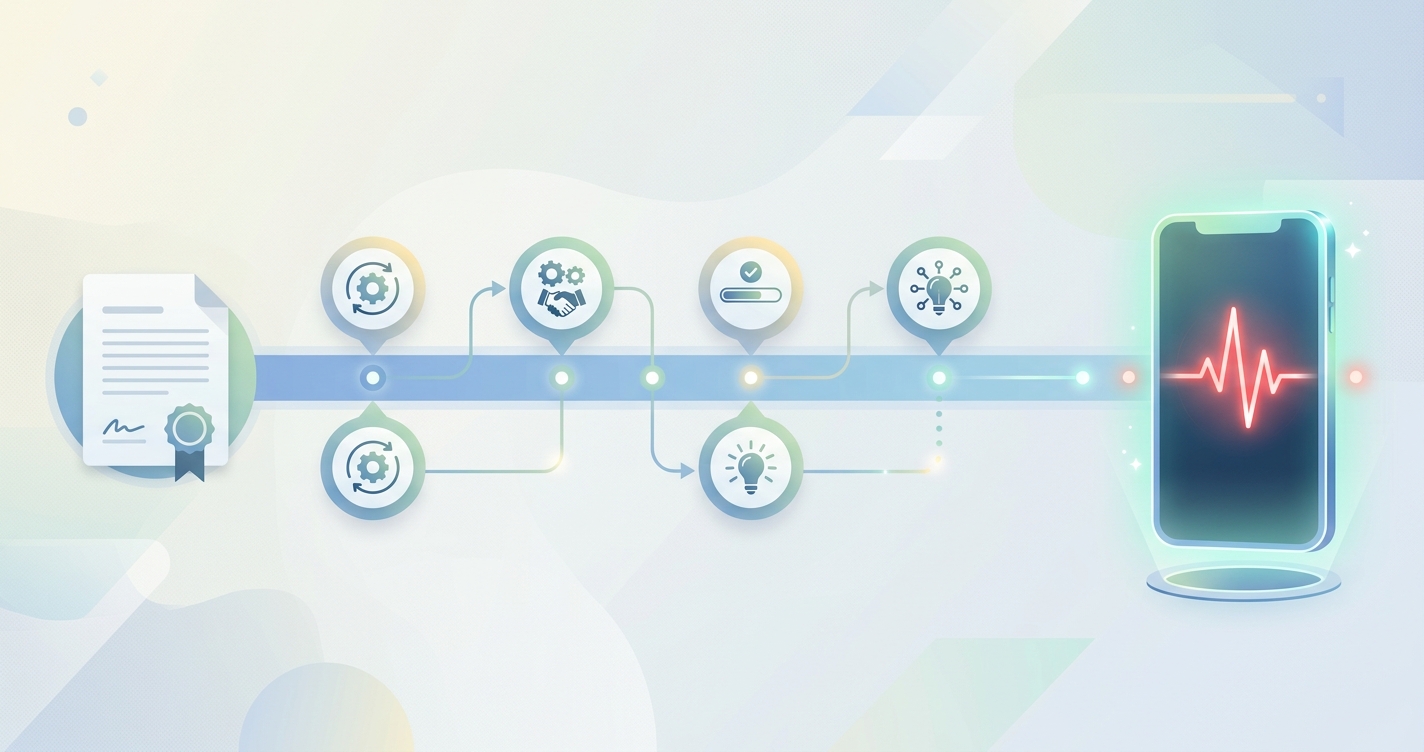
Every digital health roadmap eventually collides with the same uncomfortable question from finance and the board: when will this actually ship? For founders and product managers evaluating contactless vitals, the white label health platform launch time is the variable that decides whether a feature reaches users this quarter or next year. The honest answer is that timelines vary widely, and most of the variance has nothing to do with the underlying engine. It comes from branding decisions, integration scope, regulatory posture, and how disciplined the testing phase is. Understanding where the weeks actually go is the difference between a clean launch and a slipping deadline that burns runway.
Custom healthcare apps typically take 4 to 6 months for a basic MVP and 10 to 14 months for enterprise builds with EHR integration, according to development analyses from ScienceSoft (2025), while white-label configurations can compress that to a matter of weeks.
What determines white label health platform launch time
The phrase "launch in days" gets thrown around in vendor marketing, and it is technically possible for a stock configuration with no customization. But that is rarely what a serious health company ships. A realistic white label health platform launch time depends on four levers: how much the brand layer diverges from defaults, how many systems the platform must talk to, the regulatory classification of the product, and the depth of validation the buyer demands before going live.
A useful way to think about it is to separate the engine from everything wrapped around it. The vitals measurement layer, whether camera-based rPPG or another modality, is already built and maintained by the vendor. What you are scheduling is integration, configuration, and verification, not core research and development. That reframing is why time to market for a branded health app can be measured in weeks rather than the 6 to 12 months that custom development analyses cite for ground-up builds.
Here is how the major deployment paths compare on time, cost exposure, and control.
| Deployment Path | Typical Launch Time | Engineering Burden | Brand Control | Best Fit |
|---|---|---|---|---|
| Build vitals in-house | 10 to 18 months | Very high | Full | Teams with deep CV and regulatory staff |
| White-label, stock config | 1 to 3 weeks | Minimal | Limited theming | Pilots and proofs of concept |
| White-label, custom branded | 6 to 12 weeks | Low to moderate | Full UI and brand | Most production launches |
| White-label, deep EHR integration | 10 to 16 weeks | Moderate | Full | Hospital and enterprise telehealth |
The pattern is consistent across the industry: the faster you want to launch, the more you accept default behavior, and the more you customize, the more the calendar stretches. The work is to find the point where branding and integration meet your real requirements without padding the schedule with nice-to-haves.
A realistic phase-by-phase timeline
Breaking the journey into phases makes the health app deployment timeline for 2026 far easier to defend to stakeholders. Most production white-label engagements move through five stages.
- Contract and scoping (week 0 to 1): Legal, data processing agreements, and a technical scoping session that locks the feature set. Skipping a tight scope here is the single most common cause of later slippage.
- Branding and theming (week 1 to 4): Logo, color system, typography, copy, onboarding flows, and store listing assets. This runs in parallel with early integration work when managed well.
- Integration (week 2 to 8): Embedding the SDK or API, wiring authentication, connecting to your app or portal, and optionally linking an EHR or data warehouse. SDK integration alone can run from a few days to several weeks per system, per iTechArt's 2025 development guidance.
- Testing and validation (week 6 to 12): Functional QA, device coverage testing, security review, and any clinical or accuracy verification your use case requires.
- Launch and rollout (week 10 to 14): Staged release, app store submission, monitoring, and a feedback loop for the first cohort of users.
The phases overlap. A team that treats branding and integration as sequential steps adds avoidable weeks. The fastest credible production launches run branding, integration, and test planning concurrently and reserve the final stretch purely for validation.
How fast can you add vitals specifically?
When the only goal is to add vitals to an existing app that already handles accounts, scheduling, and compliance, the scope narrows dramatically. The question "how fast to add vitals" usually resolves to the integration and testing phases alone, because the brand and infrastructure already exist. In that scenario, a contactless vitals capability can move from kickoff to a tested beta in roughly four to eight weeks, assuming the host app exposes clean integration points and the team has device test coverage ready.
Industry applications and how they shift the timeline
The same platform launches on very different schedules depending on who is deploying it.
Telehealth Platforms
Telehealth product teams usually already own the patient relationship and the app. Their critical path is integration and making the vitals flow feel native inside an existing visit workflow. Because the surrounding compliance and identity systems exist, these teams often hit the faster end of the range, frequently a branded launch in six to ten weeks.
Digital health startups
Early-stage founders often need the brand layer built from close to zero, which front-loads design work. The advantage is fewer legacy systems to integrate against, so while branding takes longer, integration is cleaner. Quick launch health monitoring is realistic for startups precisely because they are not negotiating with a decade of inherited infrastructure.
Hospital and Enterprise IT
Hospital deployments carry the longest timelines, not because of the technology but because of procurement, security review, and EHR integration. The validation phase expands to satisfy clinical governance. These projects typically land in the 12 to 16 week range, and the schedule is dominated by review cycles rather than engineering.
Current research and evidence
Independent development analyses converge on a clear gap between building and licensing. ScienceSoft's 2025 healthcare app analysis places a basic custom MVP at 4 to 6 months, specialty platforms at 6 to 9 months, and enterprise EHR-integrated apps at 10 to 14 months. iTechArt's 2025 review of white-label telemedicine development emphasizes that pre-built modules and pre-integrated SDKs are the primary accelerant, while each additional custom integration can add days to weeks.
The research also flags a recurring risk: regulatory compliance and quality assurance are consistently named as the phases most likely to be underestimated. HIPAA alignment, data processing agreements, and security review are not optional steps that can be compressed away. They are fixed costs in the timeline that disciplined teams schedule early rather than discovering late. The evidence suggests that the teams hitting aggressive launch dates are not cutting validation. They are starting it on day one and running it alongside integration.
The future of white-label health platform launches
The direction of travel for 2026 and beyond is toward shorter integration phases and longer relative emphasis on validation and brand differentiation. As platform APIs standardize and pre-built connectors for common EHR and identity systems mature, the integration weeks compress. That shifts the competitive question away from "how fast can we wire it up" toward "how distinctive is our branded experience and how rigorously have we tested it."
Two trends will shape launch timelines. First, modular configuration is replacing custom code for an increasing share of deployment work, which moves effort from engineering to product configuration. Second, buyers are getting more sophisticated about validation, which means the testing phase may lengthen even as integration shrinks. The net effect is a launch profile that is faster overall but more concentrated on the phases that protect users and the brand.
Frequently asked questions
How long does a white-label health platform take to launch? A stock configuration can go live in one to three weeks, while a fully branded production launch typically takes six to twelve weeks. Deep EHR integration for enterprise deployments extends that to roughly ten to sixteen weeks. The variance is driven by branding depth, integration scope, and validation requirements rather than the core engine.
What is the fastest realistic time to market for a branded health app? For a team that already owns its app and compliance infrastructure and only needs to add vitals, a tested beta is achievable in four to eight weeks. Achieving that requires clean integration points, ready device test coverage, and parallel branding and validation work.
Which phase causes the most delays? Testing and regulatory validation are the most commonly underestimated phases. Security review, data processing agreements, and device coverage testing are fixed costs that should be started at kickoff. Teams that defer them to the end are the ones that miss launch dates.
Does adding EHR integration significantly extend the timeline? Yes. EHR integration typically adds several weeks because of additional security review, data mapping, and clinical governance. It is the main reason hospital deployments run longer than startup or telehealth launches, even when the underlying vitals technology is identical.
If a defensible launch date is part of your roadmap, the right move is to scope branding, integration, and validation as parallel tracks from the start rather than discovering the dependencies mid-project. Circadify is addressing this space with a fully white-labeled contactless vitals engine designed to drop into your brand and your stack, so your team spends its weeks on differentiation and testing instead of rebuilding the core. To map a realistic timeline for your specific app and integration scope, start a launch consultation at circadify.com/custom-builds.