
Where does the video go when an app scans my face for vitals?
A look at on-device vs. cloud processing for camera-based vitals, exploring the privacy and data security implications of where video frames are analyzed.
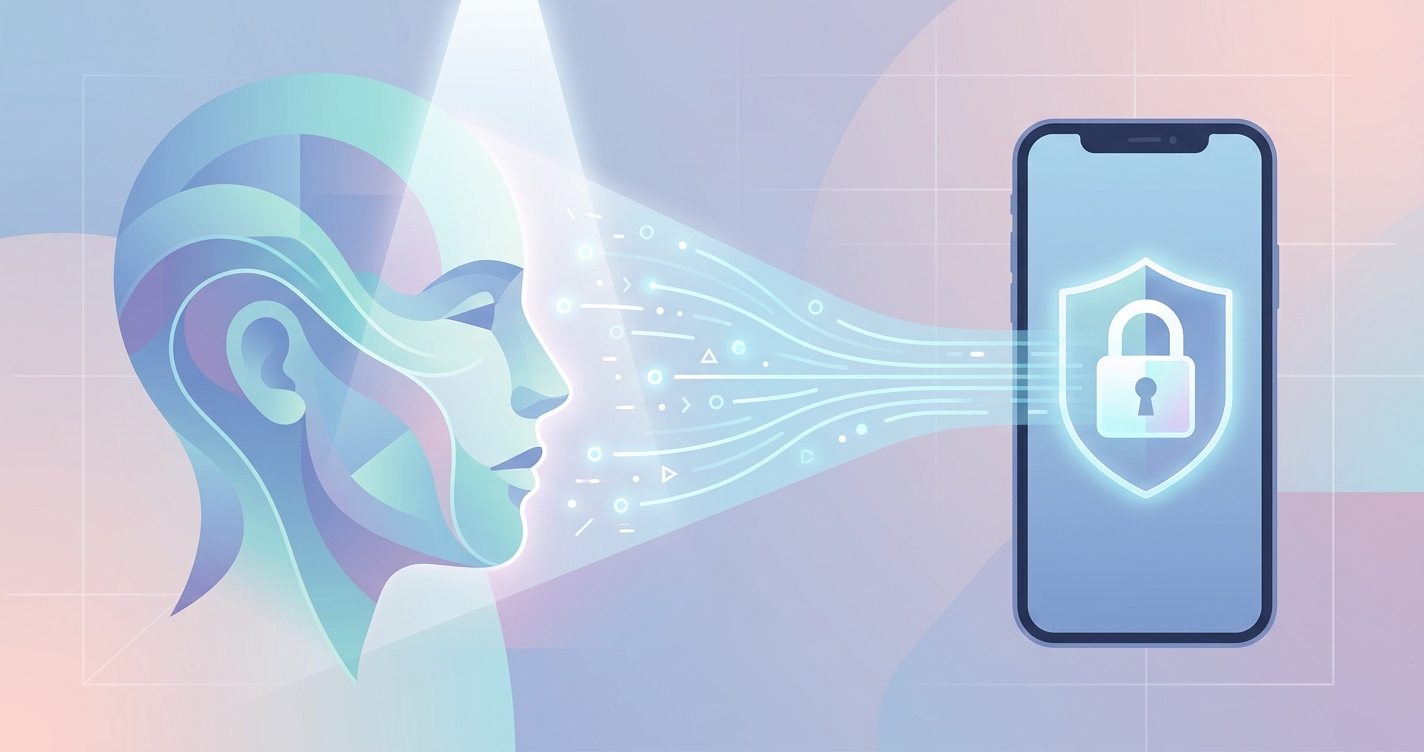
The rise of contactless health monitoring has introduced a powerful and convenient way to measure vital signs: the smartphone camera. Using a technique called remote photoplethysmography (rPPG), applications can analyze a short video of a person's face to extract physiological data like heart rate and respiratory rate. For users, the process is simple. But for the digital health founders and platform product managers implementing this technology, it raises a critical question that directly impacts user trust: where does the video go?
"Fewer consumers trusted companies to protect their data in 2023, with only half believing the benefits of online services outweighed privacy concerns, a 9 percentage point drop from 2021."
- Deloitte, 2023 U.S. report on consumer data privacy
Camera vitals privacy data: on-device vs. cloud processing
The central issue of camera vitals privacy data comes down to architectural choices made by the application developer or the white-label platform provider. When an app uses rPPG, it analyzes the video stream to detect subtle, imperceptible changes in the color of light reflected off the skin. These changes correspond to the user's blood volume pulse. The core privacy question is where this analysis occurs: on the user's own device or on a remote server.
On-Device Processing: In this model, the video frames captured by the camera are processed directly on the smartphone or tablet. The rPPG algorithm, often powered by a compact, efficient AI model, runs locally. The video data never leaves the device. Only the final, calculated vital signs (e.g., a heart rate of "68 bpm") are transmitted to the application's backend for storage or display.
Cloud-Based Processing: In this alternative architecture, the raw video frames are uploaded to a remote server. The server, which has significant computational resources, then runs the rPPG algorithm. Once the analysis is complete, the server sends the resulting vital signs back to the user's device and may store the video, the results, or both.
For platforms handling sensitive health information, the choice between these two methods has profound implications for security, privacy, and regulatory compliance.
| Feature | On-Device Processing | Cloud-Based Processing |
|---|---|---|
| Data Privacy | High. Raw video never leaves the user's device, eliminating the risk of interception or server-side data breaches. | Lower. Raw video is transmitted over a network and stored on a server, creating multiple points of potential vulnerability. |
| Latency | Low. Analysis is performed locally, providing near-instantaneous results without network lag. | High. Dependent on internet connection speed for upload and download, which can introduce significant delays. |
| Internet Dependency | None. Core functionality works offline, as no data needs to be sent to a server for processing. | Absolute. Requires a stable internet connection to upload the video file for analysis. |
| User Trust | Higher. Users can be assured that a video of their face is not being stored or analyzed by a third party. | Lower. Users must trust the provider to securely handle, store, and eventually delete their personal video data. |
| Infrastructure Cost | Low. The processing load is distributed across user devices, requiring no heavy server-side computation. | High. Requires scalable, powerful, and secure servers to handle video uploads and AI-driven analysis from all users. |
| Compliance | Simpler. Significantly simplifies adherence to regulations like HIPAA and GDPR by minimizing the surface area of protected health information (PHI). | More Complex. Requires robust Business Associate Agreements (BAAs), stringent data handling protocols, and proof of secure data transit and storage. |
The advantages of a privacy-first, on-device architecture
For telehealth platforms, digital health startups, and hospital IT departments evaluating this technology, an on-device processing model offers clear benefits:
- Minimized Data Breach Risk: The most secure data is data that is never transmitted. By keeping the raw video on the user's phone, the risk of that video being exposed in a data breach is completely mitigated.
- Simplified Regulatory Compliance: Health data regulations like HIPAA place strict rules on the transmission and storage of PHI. Because on-device processing means the video (which can be considered a biometric identifier) is not sent to the cloud, the compliance burden on the healthcare provider is substantially reduced.
- Enhanced User Trust and Adoption: In a market of increasing skepticism about data privacy, being able to state clearly that the application does not upload or store user videos is a powerful differentiator.
- Improved Performance and Accessibility: On-device processing is faster and works without an internet connection, making the feature more reliable and accessible, especially in areas with poor connectivity.
Industry Applications
White-label telehealth platforms
For companies providing white-label health monitoring solutions, offering an on-device rPPG engine is a key selling point. Their clients-the telehealth providers-can build their branded apps with the confidence that they are not creating new, significant data privacy liabilities.
Corporate wellness programs
Employee wellness programs that use health screening tools must overcome privacy objections. An app that measures vitals without sending video to the employer's or a third-party's server is more likely to see adoption and avoid internal resistance.
Remote patient monitoring (rpm) and hospital-at-home
In clinical settings, data integrity and security are critical. Hospital IT teams favor solutions that integrate easily into existing secure data workflows. Processing video on-device and transmitting only the discrete data points (the vital signs) aligns with the principle of least privilege and simplifies security reviews.
Current research and evidence
The privacy implications of rPPG are an active area of academic research. The core challenge is that the physiological signal is intertwined with a user's biometric facial identity. Researchers are working on methods to separate the two, preserving privacy without sacrificing accuracy.
A 2024 study published in the IEEE Journal of Biomedical and Health Informatics by researchers Jieying Wang, Caifeng Shan, and others, titled "Facial Privacy Protection for Remote Photoplethysmography," explores this very issue. Their work proposes a face anonymization module that can eliminate identifiable biometric features from facial videos while preserving the underlying physiological information needed for rPPG. This type of research shows a clear path forward where privacy is not just a policy but is built into the algorithm itself. It confirms that the technological trend is toward solutions that do not require a trade-off between user privacy and functional performance.
The future of contactless vitals measurement
The future of camera-based vitals is on-device. As the specialized AI models that power rPPG become more efficient and as smartphone processors become more powerful, the need to send raw video to the cloud for analysis is disappearing. This trend aligns with a broader movement in the technology industry toward "edge computing" and "privacy by design." For organizations in the digital health space, selecting a technology partner who prioritizes on-device processing is not just a technical decision-it is a strategic one that demonstrates a commitment to user privacy and data security from the ground up.
Frequently asked questions
-
Is on-device processing less accurate than cloud processing? Not necessarily. The accuracy of rPPG depends on the quality of the algorithm, lighting conditions, and camera quality-not where the processing occurs. A well-optimized on-device AI model can achieve the same level of accuracy as a server-side counterpart, without the privacy risks.
-
Does the video from a face scan get stored on the phone? In a properly designed on-device system, the video is processed in real-time on a frame-by-frame basis and is not permanently stored on the phone. The frames are held in memory only as long as needed to perform the calculation and then discarded.
-
What data security standards apply to camera-based vitals? If the resulting vital signs are used for clinical purposes, they are considered Protected Health Information (PHI) under HIPAA in the United States. Therefore, their transmission and storage must be handled with HIPAA-compliant security measures. The raw video itself, if transmitted or stored, can also be considered PHI.
-
Can the raw video be reconstructed from the vital signs data? No. The output of an rPPG system is a set of time-series data points (like heart rate, HRV, etc.). The original video frames cannot be reverse-engineered or reconstructed from this numerical data.
As digital health platforms become an increasingly integral part of healthcare delivery, the choices we make about data architecture have lasting consequences. Building on a privacy-first vitals platform is essential for earning and keeping user trust. At Circadify, we are focused on providing a white-label engine that enables this future. To learn more about integrating a privacy-first contactless vitals solution into your platform, explore our options for custom-builds and see how our technology can serve your users at getcircadify.