
What Is a White-Label Vitals Engine? Build vs License Explained
A research-backed look at white label vitals engine build vs license decisions, including speed, compliance, integration depth, and long-term platform control.
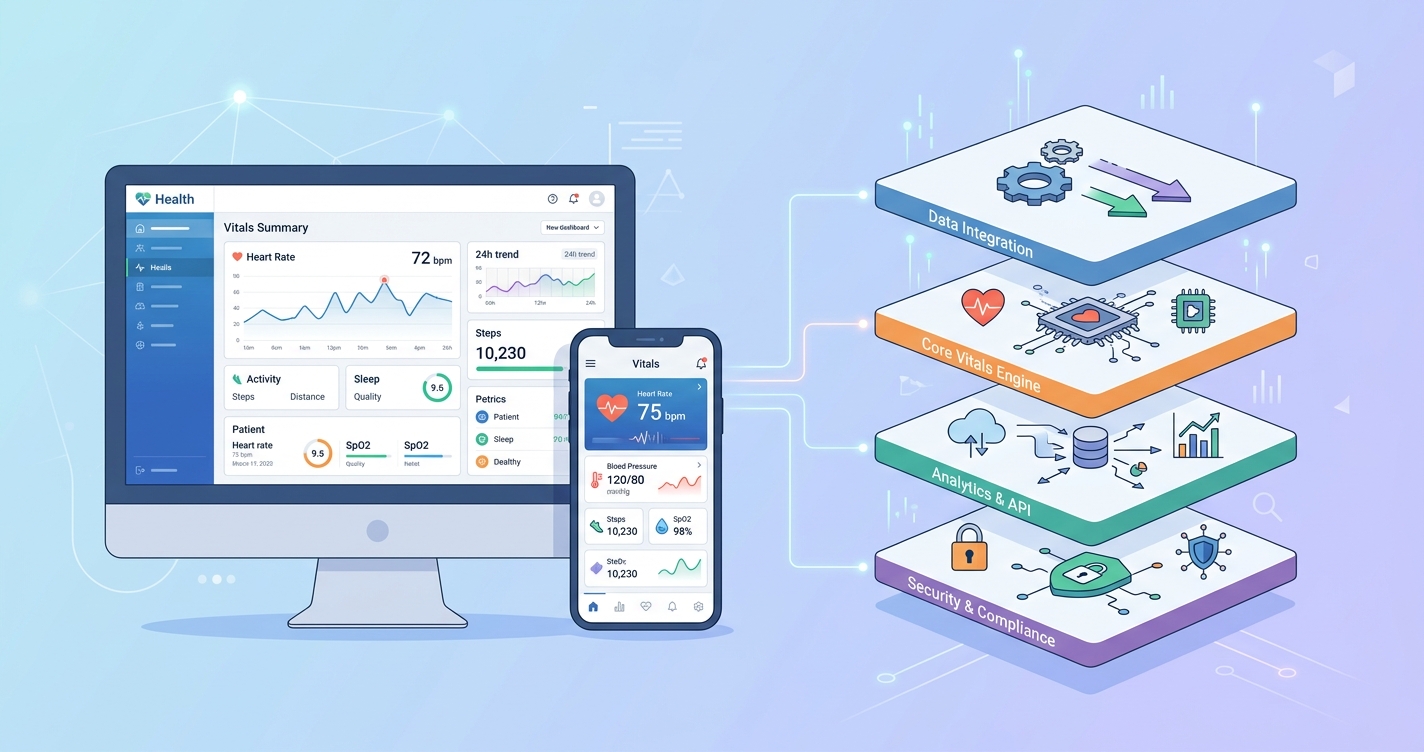
For digital health teams, the phrase white label vitals engine build vs license sounds like a procurement question. It is not. It is a product strategy question, a timing question, and in a lot of cases a survival question. If your company wants camera-based vitals, branded monitoring workflows, or contactless screening inside an existing offering, the real choice is whether to spend the next year building infrastructure or spend the next quarter shipping it.
“Even when commercial off-the-shelf technology is used, substantial custom development is frequently required.” — Barry G. Saver, Jenna L. Marquard, Jeremy Gummeson, Joanne Stekler, and James M. Scanlon, Buy or Build: Challenges Developing Consumer Digital Health Interventions
White-label vitals engine build vs license starts with one basic distinction
A white-label vitals engine is a prebuilt technology layer that measures or manages health data and can be launched under another company’s brand. In practice, that usually means the buyer licenses core infrastructure such as signal processing, dashboards, APIs, user management, and workflow controls, then applies its own product identity and operating model on top.
Building from scratch means the buyer owns the full stack. That includes product design, engineering, testing, hosting, security controls, integrations, and ongoing maintenance. Licensing means the buyer still owns the user experience strategy and commercialization plan, but a large share of the underlying infrastructure already exists.
That boundary matters more in health tech than in ordinary SaaS. Compliance reviews are heavier. Integration requirements are messier. Product timelines are tied to pilots, payer cycles, provider contracts, and fundraising windows. IQVIA’s Digital Health Trends 2025 makes essentially this point: digital health adoption now depends less on novelty and more on business-model maturity, reimbursement pathways, and clean workflow fit.
| Decision area | Build from scratch | License a white-label vitals engine |
|---|---|---|
| Core product ownership | Full ownership of infrastructure and roadmap | Shared roadmap at the engine layer, full ownership of brand and service design |
| Time to launch | Often measured in quarters | Often measured in weeks or a few months |
| Engineering burden | High from day one | Lower, with effort shifted to integration and configuration |
| Compliance workload | Buyer must design and maintain controls | Much of the baseline platform work may already exist |
| Customization depth | Highest possible | High, but constrained by the licensed architecture |
| Capital required up front | Usually higher | Usually lower |
| Long-term flexibility | Maximum flexibility, maximum upkeep | Faster path now, with some dependence on vendor capability |
I think this is where teams get tripped up. They treat licensing as a shortcut and building as the serious option. That is too simple. In a lot of cases, licensing is the serious option because it forces discipline about what your company actually needs to own.
What companies are really licensing
A white-label vitals engine is not just a widget dropped into an app. In stronger platform models, the buyer is licensing several layers at once:
- signal processing or measurement logic
- branded front-end experiences or configurable UI modules
- clinician or admin dashboards
- API access for integration into existing workflows
- account controls, permissions, audit trails, and reporting
- hosting, monitoring, and platform updates
That matters because the build-vs-license decision changes depending on which layer is strategic. If your differentiation sits in care pathways, channel partnerships, or a branded user journey, owning the raw measurement engine may not create much advantage. If the measurement engine itself is your product, the answer changes.
Why build is harder than it sounds
Barry G. Saver and colleagues did not study white-label vitals engines specifically, but their findings are still useful here. In their paper on buy-or-build challenges for consumer digital health interventions, they described how commercial components still required meaningful custom work because of mismatched technologies, unstable dependencies, and unplanned use cases. That should sound familiar to anyone who has ever been told a health feature is “almost ready” until real implementation begins.
The harder part is not writing code once. It is keeping the system reliable while everything around it changes.
CHIME and KLAS made a related point in Digital Health Most Wired National Trends 2025. Their argument was that digital maturity is now defined by governance, integration, and accountability rather than raw feature count. That is a polite way of saying health platforms fail in the seams. They fail when data models do not line up, when permissions drift, when reporting breaks, or when teams cannot support the workflow they sold.
For most buyers, the hidden build costs show up in places like these:
- extended QA cycles across mobile, web, and clinical admin surfaces
- interoperability work with EHR, CRM, or identity systems
- security reviews and policy documentation
- operational monitoring after launch
- engineering time spent on platform maintenance instead of buyer-facing differentiation
Where licensing usually makes more sense
Licensing tends to be stronger when a company needs a credible launch path without turning infrastructure development into its main business.
Farnia Velayati, Haleh Ayatollahi, Morteza Hemmat, and Reza Dehghan wrote in their JMIR systematic review that telehealth business models succeed or fail on value proposition, financial structure, and delivery design, not just on technical capability. That is a useful frame for white-label decisions. If speed to market and capital efficiency sit near the center of your model, licensing can be the cleaner fit.
A licensed engine is often the better path when:
- the company needs to launch a branded offer within a contract window
- the buyer already has distribution but not a large infrastructure team
- the product thesis depends more on workflow design than on owning sensing technology
- the organization wants to test a market before hiring a full platform team
- multi-tenant or multi-brand deployment is part of the commercial plan
McKinsey’s 2025 analysis of health services and technology revenue pools also points in this direction. The firm projects continued growth in software platforms and advanced data and analytics, which is one reason buyers increasingly want platform leverage instead of rebuilding the same infrastructure in-house.
When building is still the right call
None of this means licensing always wins.
Building from scratch still makes sense when the underlying engine is the company’s defensible asset, when the buyer needs unusually deep control over workflow logic and infrastructure behavior, or when the economics of scale clearly justify long-term ownership. There are also cases where a team wants white-label speed first and a staged transition to deeper ownership later. That hybrid path is becoming more common because it lowers early risk.
| Best fit question | Build | License |
|---|---|---|
| Is the vitals engine itself your main IP? | Usually yes | Usually no |
| Do you need launch speed more than engine ownership? | Usually no | Usually yes |
| Can your team support continuous platform maintenance? | Required | Less internal burden |
| Do you need unusual workflow or data-model control? | Stronger fit | Depends on vendor flexibility |
| Are you proving demand before deeper investment? | Risky | Often a better first move |
The mistake is assuming that “control” always creates value. Sometimes control just creates payroll.
Industry applications
Digital health startups
Startups often license first because timing is brutal. If a founder needs a pilot, partnership, or early revenue story, spending twelve months building base infrastructure can burn the advantage before the product reaches market.
Telehealth platforms
Telehealth teams usually care about integration depth. A white-label vitals engine works well when the goal is to add a branded monitoring capability quickly. A custom build becomes more attractive if the vitals layer must behave like a deeply native part of an existing clinical application.
Hospital and enterprise IT teams
Enterprise buyers rarely ask only whether the engine works. They ask how it fits governance, access control, reporting, and integration requirements. That is where licensing can help if the platform already supports mature admin controls, but it can also fall short if the buyer needs unusual workflow ownership.
Current research and evidence
The broader research base does not say “always build” or “always buy.” It says the success of digital health infrastructure depends on fit.
Saver, Marquard, Gummeson, Stekler, and Scanlon showed that buy-or-build decisions in digital health still create hidden customization work, even when commercial components look ready on paper. Velayati and coauthors showed that telehealth success depends on business model design, not just technical features. CHIME and KLAS argued in 2025 that integration and governance now define maturity. And the ONC HTI-1 final rule, published in January 2024, raised the interoperability bar again by setting USCDI Version 3 as the baseline for the ONC Health IT Certification Program beginning in 2026.
Put together, those signals point to a pretty practical conclusion: a white-label vitals engine is not a compromise if it gives the buyer faster market entry, credible governance, and enough configuration headroom to support real workflows.
| Source | Key takeaway | Relevance to build vs license |
|---|---|---|
| Saver et al. | Even “buy” paths often require customization and adaptation | Buyers should evaluate integration effort honestly, not assume zero work |
| Velayati et al. | Telehealth business models depend on value delivery and financial structure | Licensing can be rational when speed and commercialization matter most |
| CHIME + KLAS (2025) | Governance, integration, and accountability now define digital maturity | Platform selection should focus on operational fit, not just features |
| ONC HTI-1 (2024) | Interoperability expectations continue to tighten heading into 2026 | Buyers need engines that can support credible data exchange paths |
| IQVIA (2025) | Adoption depends on workflow fit and market maturity | Faster launches only matter if the platform fits how care is actually delivered |
The future of white-label vitals engines
I do not think the market is heading toward a clean winner. It is heading toward modularity.
More teams will license baseline engine infrastructure and keep their differentiation in workflows, analytics, and customer relationships. More enterprise buyers will ask for exit paths, deeper API access, and portability clauses before signing. And more vendors will try to meet in the middle with hybrid models that start white-label and expand into embedded or custom deployments later.
That feels like the sane direction. Health companies do not need to reinvent every infrastructure layer to build a real business. They do need to know which layers actually matter.
Frequently asked questions
What is a white-label vitals engine?
A white-label vitals engine is a prebuilt measurement and monitoring platform that another company can brand as its own. It usually includes core infrastructure such as vitals processing, dashboards, APIs, and admin controls.
Is licensing a vitals engine the same as buying a finished app?
Not always. Some white-label offers are close to a finished application, while others are platform layers with configurable front ends and APIs. The important question is how much workflow and integration control the buyer keeps.
When should a company build instead of license?
Building makes more sense when the vitals engine itself is the company’s core IP, when the buyer needs unusual control over infrastructure behavior, or when long-term scale economics justify full ownership.
Does licensing reduce differentiation?
It can reduce differentiation at the infrastructure layer, but many companies differentiate elsewhere: clinical workflows, service design, integrations, distribution, reporting, and customer experience. That is often enough.
If your team is sorting through launch speed, branding, and integration depth, solutions like Circadify Custom Builds are aimed at companies that want a branded path to market without committing to a full platform build on day one.
Related reading on this site: White-Label vs Build From Scratch: Cost and Timeline Compared, White-Label vs Embedded SDK: Choosing the Right Integration Depth, and What Is Platform OEM Licensing? White-Label Health Tech Models Explained.