
What Is Platform OEM Licensing? White-Label Health Tech Models Explained
A research-backed analysis of health platform OEM licensing models, including white-label structure, pricing logic, compliance boundaries, and interoperability in 2026.
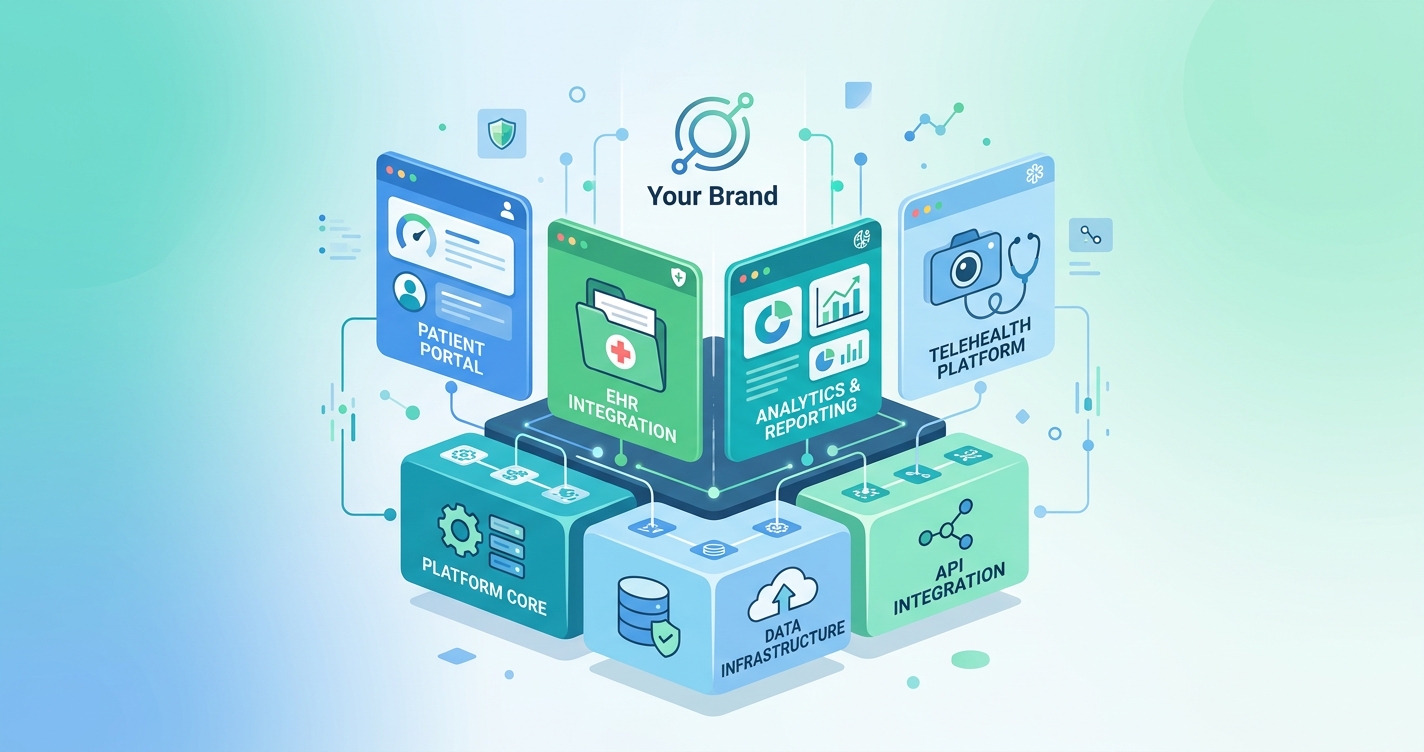
The phrase health platform OEM licensing models explained tends to sound more complicated than it is. In practice, buyers are usually asking a simple question: if we want to launch a branded health product without building every layer ourselves, what exactly are we licensing, what do we control, and where do the operational boundaries sit? For digital health founders, telehealth product teams, and hospital IT leaders, that question has become more urgent as platform timelines collide with tighter funding, stricter interoperability rules, and higher buyer expectations around governance.
"Applying business models in telehealth commercialization helps in understanding the required components, market challenges, and future changes." — systematic review in JMIR Formative Research (2022), reviewing 4,998 records and 23 included studies
Health platform OEM licensing models explained: what buyers are actually buying
In software, OEM usually means one company builds the core technology and another company licenses it to distribute under its own brand. In health tech, the same logic applies, but the stakes are higher because branding is only one layer. Buyers also care about workflow control, data boundaries, implementation speed, integration options, and regulatory responsibilities.
That is why platform OEM licensing is rarely just a logo swap. A serious health platform deal usually bundles several layers together:
- access to the underlying application or platform engine
- rights to brand the experience as the buyer's own product
- configuration options for workflows, permissions, dashboards, and care pathways
- commercial terms tied to seats, usage, tenants, or revenue share
- support obligations around uptime, onboarding, and product updates
- defined boundaries for compliance, hosting, and interoperability work
Zhong Wang, Rui Xu, Yan Liu, and Yiming Li wrote in Frontiers in Public Health in 2023 that telemedicine platform development is shaped not only by technology, but by the licensing policy around who can provide services and how the platform is organized. That is a useful reminder. In health care, the licensing model is never just a finance decision. It changes the operating model.
| OEM model | What the buyer licenses | What the buyer usually controls | Best fit | Main tradeoff |
|---|---|---|---|---|
| Pure white-label platform | Full application layer with branding rights | Brand, messaging, some workflow settings | Fast market entry | Less control over deep product architecture |
| Configurable multi-tenant platform | Shared core platform with tenant-specific configuration | Roles, workflows, dashboards, customer environment | Operators serving multiple programs or business units | Governance gets more complex as tenants expand |
| OEM + API extension | Core platform plus developer hooks | Brand, selected workflows, custom integrations | Teams that need speed without giving up all flexibility | More implementation work than pure white-label |
| Revenue-share or embedded OEM | Platform plus commercial distribution model | GTM packaging and customer relationships | Partnerships where both sides share upside | Contract structure can get messy fast |
That table gets at the real decision. OEM licensing is not one thing. It is a range of commercial and technical arrangements built around the same basic premise: one company owns the engine, another owns the customer-facing offer.
Why OEM licensing keeps gaining ground in digital health
I keep coming back to timing here. Platform OEM deals make the most sense when time-to-market matters more than owning every layer from day one.
Rock Health reported that U.S. digital health companies raised $6.4 billion across 245 deals in the first half of 2025, with AI-enabled companies taking 62% of that funding and raising materially larger rounds on average. That does not mean every startup should license instead of build. It does mean capital is rewarding companies that can get into market, prove demand, and keep scope under control.
The IQVIA Institute's Digital Health Trends 2025 report describes a market that is moving away from standalone wellness tools and toward broader care platforms, diversified revenue models, and stronger evidence expectations. IQVIA also noted that more than 300 billing codes now support digital health solutions or digital care in the United States, including 117 tied to software-based technologies. In other words, the market is getting more platform-shaped, not less.
That favors OEM structures when buyers need to:
- launch a branded offer in weeks rather than quarters
- test demand before making large engineering hires
- expand from one workflow into multiple customer-specific deployments
- enter regulated markets with fewer unknowns in the base stack
- keep product teams focused on differentiation instead of undifferentiated infrastructure
None of that makes OEM the obvious answer in every case. But it does explain why the model keeps showing up in board decks, procurement reviews, and partner conversations.
Where OEM licensing terms usually get negotiated
This is the part buyers underestimate. The contract is not just about access to software. It is about control.
WIPO's guidance on licensing models and contract structures for health innovation makes a pretty basic but important point: licensing agreements work because they clearly define scope, rights, exclusivity, field of use, and responsibilities between the parties. In digital health, those clauses become operational very quickly.
The negotiation usually revolves around five areas:
- brand rights: can the buyer fully white-label the interface, domain, onboarding, and communications?
- configuration rights: what can be changed without vendor engineering involvement?
- data rights: who stores, accesses, exports, and governs the resulting data?
- commercial logic: is pricing based on users, scans, enterprise tenants, or a minimum annual commitment?
- product roadmap rights: does the licensee get influence over features, SLAs, or integration priorities?
That last one matters more than people admit. A buyer may think it has licensed a platform, then discover it has really licensed a fixed product with limited configuration. Those are very different things.
Interoperability changes what a good OEM model looks like
An OEM arrangement that cannot plug into the rest of the health stack will feel fine in a demo and painful in production.
The Office of the National Coordinator's HTI-1 final rule, released in late 2023, pushed certified health IT further toward modern API-based interoperability and established the move to USCDI Version 3 by January 1, 2026. That is not a niche policy detail. It changes buyer expectations. Even when a white-label product is not itself the certified EHR, hospital and enterprise customers increasingly expect API readiness, cleaner data exchange, and a credible interoperability story.
So when teams say they want a health platform OEM deal, what they often really mean is this:
- we want a branded platform
- we want configuration control
- we need the vendor to stay current on interoperability expectations
- we do not want every integration to become custom project work
That is why the strongest OEM offers usually combine white-label presentation with a disciplined API layer and documented implementation boundaries.
Industry applications
Digital health startups
Startups usually use OEM licensing to compress launch time. They want to prove demand with a branded product before deciding what parts of the stack deserve custom investment.
Telehealth platforms
Telehealth operators often need OEM models when adding vitals, screening, or asynchronous patient workflows under an existing brand. In that context, the platform matters less as a standalone destination and more as an embedded capability.
Hospital and provider organizations
Hospitals tend to care less about the phrase "white-label" and more about governance. They want role controls, auditability, integration paths, and clear responsibility boundaries between the internal IT team and the platform vendor.
Multi-brand health companies
For companies running several products, business lines, or partner channels, multi-tenant OEM structures can be useful because one engine supports multiple branded experiences without forcing each team to rebuild the basics.
Current research and evidence
The evidence base is not huge, but it points in a consistent direction.
The 2022 systematic review in JMIR Formative Research found that telehealth business model research repeatedly returned to value proposition, financial variables, and revenue streams as central design components. That sounds obvious, but it matters because OEM deals often fail when teams obsess over features and ignore business-model fit.
Wang, Xu, Liu, and Li's 2023 multi-case study from China showed that licensing policy can shape which platform model emerges: provider-led, internet-company-led, or government-led. I would not map those categories directly onto every U.S. commercial deal, but the broader lesson holds. Platform structure follows policy, customer type, and service permissions.
Then there is the market evidence. IQVIA's 2025 outlook points to broader reimbursement support and a more mature platform environment. Rock Health's 2025 funding data points to a market rewarding focused execution rather than endless infrastructure ambition. Put those together and OEM licensing starts to look less like a shortcut and more like a specific strategic answer to a market that expects working products.
| Source | Key finding | Practical takeaway |
|---|---|---|
| JMIR Formative Research systematic review (2022) | Reviewed 4,998 records and included 23 telehealth business model studies | OEM decisions should be evaluated as business-model choices, not just product choices |
| Wang, Xu, Liu, Li, 2023 | Licensing policy shaped telemedicine platform models across several Chinese cases | Platform structure is heavily influenced by policy and operating context |
| IQVIA Institute, 2025 | Digital health is shifting toward broader platforms, diversified business models, and expanded reimbursement pathways | Buyers want platform partners that can support long-term operational scale |
| Rock Health, H1 2025 | U.S. digital health funding reached $6.4B across 245 deals; AI-enabled firms captured 62% | Faster, clearer go-to-market models have become financially attractive |
| ONC HTI-1, 2023-2026 deadlines | Health IT rules continue pushing standardized API-based interoperability and USCDI adoption | OEM platforms need a real interoperability plan, not just branding features |
The future of platform OEM licensing
I doubt the market is heading toward a simple split between white-label and custom build. The more likely outcome is a layered middle ground.
Core health platforms will keep handling the heavy infrastructure. Buyers will keep asking for more control at the presentation, workflow, and integration layers. The winners will probably be the vendors that make those layers visible and governable without pretending every customer needs a one-off codebase.
That has a few implications for 2026:
- pricing models will keep moving toward recurring platform revenue with usage-based elements
- buyers will expect OEM agreements to include cleaner API and export rights
- platform governance will matter more as customers operate across multiple brands or care programs
- product differentiation will shift upward into workflow design, UX, and commercial packaging
The interesting thing is that OEM licensing does not reduce the need for strategy. It just changes where strategy lives.
Frequently asked questions
What is platform OEM licensing in health tech?
It is an arrangement where one company licenses a health technology platform built by another company, then offers it under its own brand, often with some level of configuration over workflows, dashboards, and user experience.
Is OEM licensing the same as white-label software?
Not always. White-label branding is usually part of the OEM arrangement, but OEM licensing can also include API access, commercial terms, implementation support, exclusivity clauses, and deeper product obligations.
When does OEM licensing make more sense than building from scratch?
Usually when speed, capital efficiency, and launch risk matter more than owning every infrastructure layer immediately. Teams still need to decide which parts of the product remain core to their differentiation.
What should buyers check before signing a health platform OEM agreement?
They should check branding rights, configuration limits, data ownership, API and integration scope, pricing mechanics, service levels, roadmap control, and compliance responsibilities.
If your team is sorting through branded platform options and needs a path between rigid off-the-shelf software and a fully custom build, solutions like Circadify Custom Builds are built for that middle ground.
Related reading on this site: White-Label Health Monitoring Explained, Evaluate White-Label Health Technology Partners: What to Ask Before You Sign, and White-Label vs Build From Scratch: Cost and Timeline Compared.