
Can an app help my family keep an eye on Grandma's health from afar?
How a remote elderly health app supports family caregiving from a distance, and what telehealth builders should know about contactless monitoring.
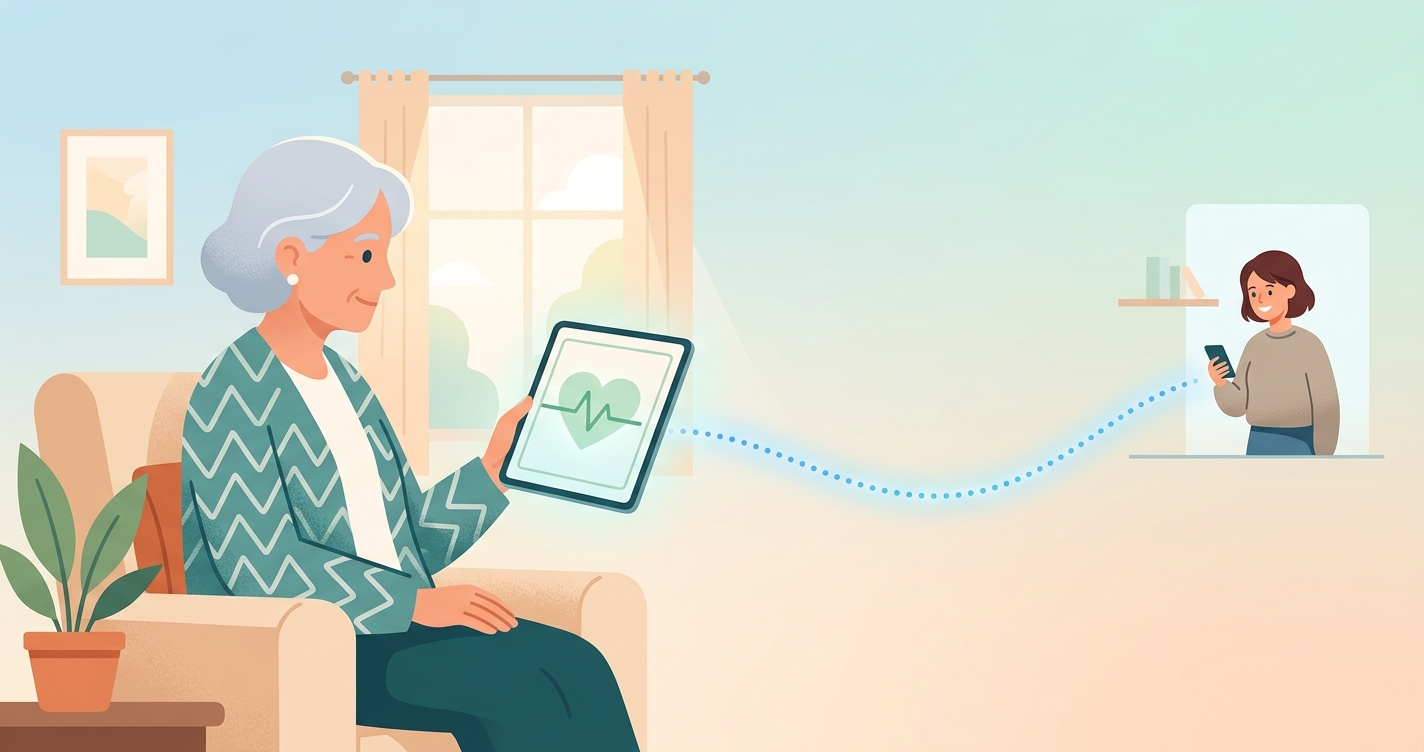
Families spread across cities and time zones increasingly want the same thing: a simple way to know whether an aging parent is doing all right between phone calls. That desire has turned the remote elderly health app into one of the more requested categories in digital health, and it sits at the intersection of two strong forces. Older adults overwhelmingly want to stay in their own homes, and adult children want reassurance without moving in or hiring round-the-clock care. For the founders and product teams building these tools, the question is no longer whether the demand exists. It is how to deliver monitoring that a 78-year-old will actually use and a worried daughter will actually trust.
In 2025, 25 percent of family caregivers reported using remote monitoring technology, up from 13 percent in 2020, while roughly 87 percent of U.S. seniors say they prefer to age in place., Technology for Aging, Market Overview 2025
What a remote elderly health app really has to solve
A remote elderly health app is software that lets an older adult capture health information at home and share it, with permission, to family members or clinicians who are somewhere else. The category sounds straightforward, but the design constraints are unusual. The primary user often has reduced dexterity, variable eyesight, and limited patience for setup. The people consuming the data, the family, are usually not in the room. And the value of the whole system rises or falls on whether the daily measurement actually happens.
That last point is where most products quietly fail. A blood pressure cuff or a finger clip works well in a clinic because a professional applies it. Left on a kitchen counter for an 80-year-old to operate alone, the same device gets used for a week and then abandoned in a drawer. The home-care segment of remote patient monitoring is projected to grow at a 25.3 percent compound annual rate through 2033, the fastest of any setting, but that growth is gated by adherence. A measurement method that demands no charging, no pairing, and no correct placement removes the most common reasons seniors stop.
This is why contactless approaches have moved from novelty to serious consideration. Remote photoplethysmography, or rPPG, uses an ordinary phone or tablet camera to detect tiny color changes in the skin that correspond to the pulse, and from that signal it can estimate heart rate, respiratory rate, and related metrics. For a family-monitoring use case, the appeal is obvious: Grandma holds up the tablet she already uses for video calls, looks at the screen for a moment, and the reading is captured and shared.
Comparing approaches to monitoring an older relative at home
Teams designing in this space usually weigh four broad models. Each carries different cost, adherence, and trust tradeoffs.
| Approach | Senior effort required | Hardware cost | Family visibility | Main limitation |
|---|---|---|---|---|
| Manual phone check-ins | High (initiate calls) | None | Subjective, infrequent | No objective data |
| Wearable devices | Medium (charge, wear, sync) | $100 to $400 per user | Continuous when worn | Abandonment, charging fatigue |
| Peripheral devices (cuff, oximeter) | High (correct placement) | $40 to $150 per device | Spot readings only | Low long-term adherence |
| Camera-based rPPG app | Low (look at screen) | None beyond existing device | Frequent spot readings | Needs adequate lighting, signal quality |
A few practical points fall out of this comparison for product teams:
- The lowest-effort method tends to win on sustained engagement, even if a higher-effort method offers richer data on paper.
- Hardware that the family must buy, ship, and support adds a logistics burden that erodes margins and slows onboarding.
- Families value frequency and consistency over clinical precision in the reassurance use case, though clinical-grade workflows are a separate matter.
- Any approach is only as good as its alerting layer, since raw numbers mean little to a non-clinical relative.
Industry applications for family-centric monitoring
Telehealth platforms adding a caregiver layer
Telehealth companies built for one-to-one video visits are discovering that the family is an underserved third party. A remote elderly health app that lets a patient designate family members as viewers, with granular consent, extends the platform's reach without shipping a single device. Camera-based capture fits naturally here because the video infrastructure is already present. The product work is mostly in permissions, dashboards, and notification design rather than in new hardware supply chains.
Aging-in-place and senior living operators
Independent living communities and home-care agencies want lightweight monitoring that does not feel clinical or intrusive. A tablet-based check-in that doubles as a social touchpoint can capture vitals trends while preserving the resident's sense of independence. Operators in this segment care intensely about staff time, so automated trend flags that route only meaningful changes to a nurse are more valuable than continuous raw feeds.
RPM and chronic care programs
For programs managing hypertension, heart failure, or COPD in older patients, adherence is the difference between a reimbursable program and a failed one. Contactless capture lowers the daily friction that causes patients to drop out. The family dimension adds an accountability partner, which several care models have found improves consistency.
Current research and evidence
The scientific base for contactless monitoring in older adults has strengthened. A 2024 study on vital signs estimation in the elderly using camera-based photoplethysmography, published through researchers affiliated with Italy's National Research Council (CNR), specifically examined how rPPG performs on aging skin, which presents different optical properties than younger skin. A June 2024 systematic review in the MDPI journal Sensors surveyed non-contact vision-based vital sign techniques for home environments and catalogued both the progress and the open challenges in motion tolerance and lighting variability.
A 2024 digital health technology evaluation study in JMIR mHealth and uHealth tested contactless monitoring of heart rate, breathing rate, and breathing disturbance during sleep in aging adults, reporting that the approach produced reliable measurements in that population. Separately, a 2024 review in Frontiers covering deep learning and rPPG documented how machine learning models have improved robustness against the exact conditions, movement and inconsistent light, that historically limited camera-based methods.
The consistent message across this work is that contactless measurement has matured past proof of concept, while accuracy still depends heavily on signal conditions and the quality of the underlying algorithm. For builders, that means the engine matters more than the interface. A polished app sitting on a weak measurement core will produce numbers families cannot rely on.
The future of the remote elderly health app
Three shifts are likely to define the next several years. First, passive and ambient capture will grow. Instead of asking a senior to perform a deliberate measurement, future systems will opportunistically read vitals during routine activities like a video call with a grandchild. Second, the analytics layer will move from single readings to personalized baselines, where the system learns an individual's normal range and flags deviations rather than applying generic thresholds. The 2025 to 2035 elderly care technology market, projected to roughly double to $93.4 billion, is being driven substantially by this kind of AI-enabled interpretation rather than by raw sensing alone.
Third, the family experience will become a product surface in its own right. The reassurance a distant relative feels comes less from a number and more from a clear, calm signal that says everything is fine, or that it is time to call. Companies that design that emotional layer well, with sensible escalation and minimal false alarms, will hold the category. The underlying measurement is becoming a component that most teams will license rather than build, freeing them to compete on the caregiving experience.
Frequently asked questions
Can a phone or tablet camera really measure an older person's vitals?
It can estimate metrics like heart rate and respiratory rate using rPPG, which reads subtle skin color changes tied to blood flow. Peer-reviewed work in 2024, including studies focused specifically on elderly skin and on sleep monitoring in aging adults, supports its feasibility, though accuracy depends on lighting, stillness, and algorithm quality.
Why is adherence such a big deal for elderly monitoring?
Because the data is only useful if the measurement keeps happening. Wearables and peripheral devices often get abandoned after a few weeks due to charging, placement, and complexity. Contactless methods that require only looking at a screen remove the most common reasons seniors stop, which is why the home-care segment is the fastest growing in remote monitoring.
How does the family fit into these apps without violating privacy?
Well-designed systems use explicit, granular consent, letting the older adult choose which relatives see what data. The family typically receives summaries and meaningful alerts rather than continuous raw feeds, which respects autonomy while still providing reassurance.
Do these apps replace a doctor or a clinical RPM program?
No. Family-reassurance monitoring and clinical remote patient monitoring are distinct use cases with different accuracy, documentation, and regulatory requirements. Many platforms support both tiers, but the consumer reassurance layer should not be presented as medical diagnosis.
Circadify is addressing this space directly with a fully white-labeled contactless vitals engine that digital health teams can wrap in their own brand and family-caregiving experience, without building the measurement core or shipping hardware. If you are designing a remote elderly health app and want the underlying technology to be someone else's problem, start a partnership conversation at circadify.com/custom-builds.