
Mobile vs Web: Where Branded Vitals Scanning Works Best
Compare deploying camera-based vitals inside a mobile app versus a web portal on reach, accuracy, and adoption for white-label telehealth platforms.
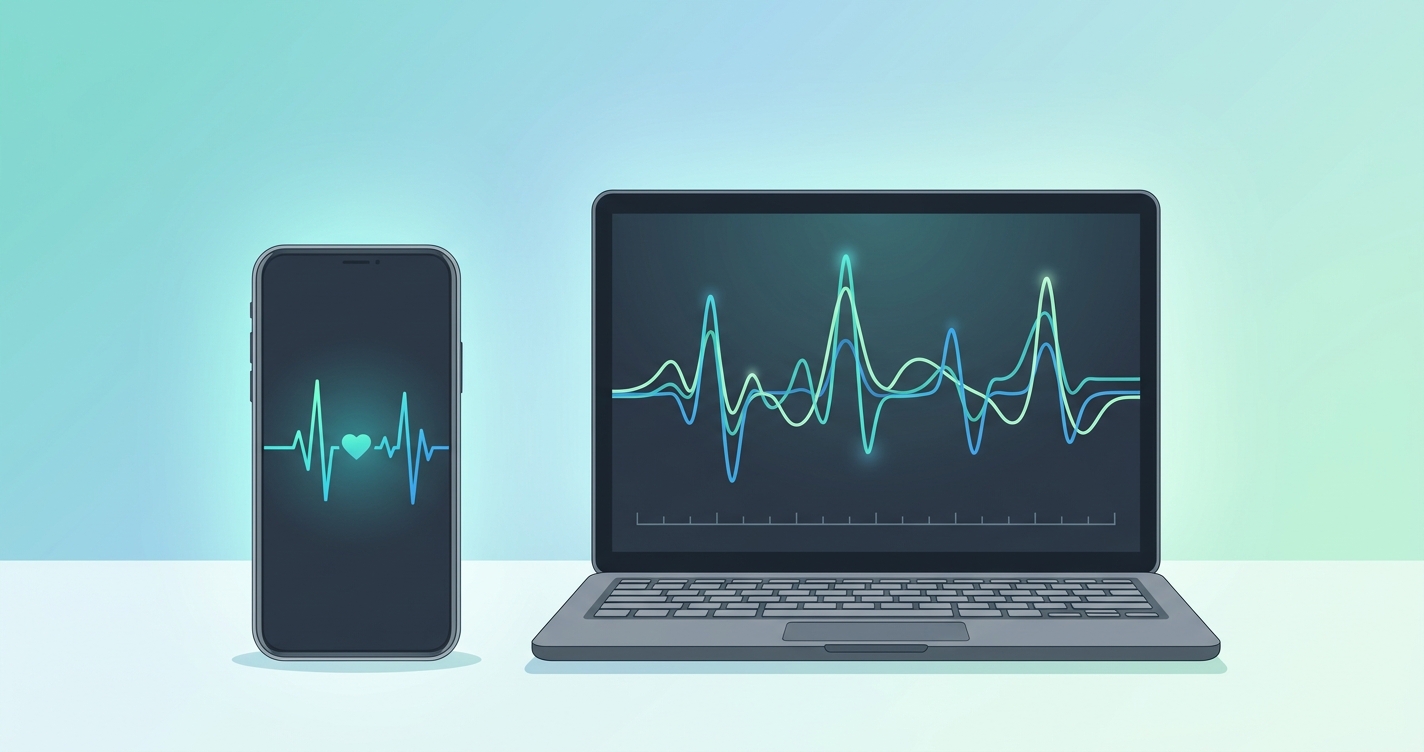
Digital health product managers evaluating a white label health monitoring platform eventually face a fundamental deployment decision. Adding contactless health assessment technology introduces a practical infrastructure choice: do you embed the software into a native iOS or Android application, or run it through the browser via a clinical web portal? The choice between mobile vs web vitals scanning dictates not just the patient experience, but the technical constraints of the underlying remote photoplethysmography (rPPG) engine. For telehealth platform administrators and hospital IT teams, balancing measurement reliability with patient accessibility requires understanding how device hardware interacts with software environments.
"In 2024, 57% of individuals reported using a mobile app to access their online medical records, up from 38% in 2020. Patients using mobile apps were more likely to view their medical records six or more times a year compared to web-based portal users." "Office of the National Coordinator for Health Information Technology (ONC), 2024 Data Brief"
The technical divide in mobile vs web vitals scanning
Remote photoplethysmography operates by analyzing micro-color changes in human skin caused by blood flow with every heartbeat. To capture these subtle variations, the software requires high-quality video frames. The deployment environment dictates how easily those frames can be acquired, processed, and translated into physiological data.
Native mobile apps: precision through control
A custom branded vitals app built natively for iOS or Android offers developers direct access to the device's hardware. Native applications bypass the limitations of generic browser protocols, allowing the software to communicate directly with the camera sensor.
This direct access provides several advantages for rPPG technology:
- Direct access to hardware acceleration for faster on-device processing.
- Granular control over exposure and white balance, which is critical for capturing subtle facial color changes.
- Stable, continuous frame rates without resource throttling imposed by a browser.
- Access to uncompressed video frames, preventing artifacts that can distort the rPPG signal.
Because the software can lock in a specific frame rate and prevent the operating system from aggressively compressing the video feed, native mobile deployments generally yield highly stable environments for heart rate, respiratory rate, and blood pressure estimation.
Web portals: the accessibility advantage
Browser based health scans operate differently. Instead of relying on native camera APIs, web portals use WebRTC (Web Real-Time Communication) to access the user's webcam or smartphone camera through the browser.
WebRTC was originally designed for video conferencing, not medical-grade data extraction. To maintain a smooth video feed over varying internet connections, browsers automatically adjust resolution, compress the video stream, and fluctuate the frame rate. These automated adjustments can introduce noise into the video feed. A sudden drop in frame rate or a spike in compression artifacts can obscure the subtle skin color changes the rPPG algorithm needs to read a pulse.
Despite these technical hurdles, web portals remain highly attractive for one primary reason: accessibility. Removing the friction of an app download significantly increases the likelihood that a patient will complete a remote health assessment before a telehealth appointment.
Architecture Comparison
When procurement teams evaluate health platform OEM technology, they must weigh the technical requirements against their patient engagement strategy.
| Feature | Native Mobile App | Web Portal (Browser) |
|---|---|---|
| Camera Control | Direct access to raw sensors and settings | Limited by WebRTC and browser constraints |
| Framerate Stability | High and consistently locked | Variable and depends on browser resource management |
| Video Compression | Uncompressed raw frames available | Heavy compression artifacts may occur |
| User Friction | Higher due to mandatory app download | Lower because it opens directly via a link |
| Development Cost | Higher due to separate iOS and Android bases | Lower due to a unified web codebase |
| Primary Use Case | Chronic care and continuous monitoring | One-off telehealth visits and quick triage |
Industry Applications
The decision to deploy an in-app vitals vs web portal solution largely depends on the frequency of the intended use case and the demographic of the target user.
Telehealth triage and urgent care
For urgent care telehealth platforms, speed is the primary metric. When a patient feels unwell and books a same-day virtual visit, asking them to navigate an app store, download a large file, create an account, and grant permissions creates unnecessary friction. In these scenarios, a web-based portal excels. The patient receives an SMS link, clicks it, and completes a browser based health scan in the virtual waiting room. The algorithm may have to work harder to filter out WebRTC compression noise, but the high completion rate justifies the technical trade-off.
Chronic care management and remote patient monitoring
Conversely, platforms focused on chronic disease management prioritize precision and long-term engagement over instant access. A patient monitoring hypertension or recovering from cardiac surgery will be checking their vitals daily. In this context, the initial friction of downloading a custom branded vitals app is acceptable. The native app provides the stable frame rates and uncompressed video necessary for precise daily measurements, while also utilizing local push notifications to drive adherence.
Current research and evidence
The academic literature reflects the ongoing evolution of both deployment methods. As machine learning models become more sophisticated, the performance gap between native and web environments is narrowing, though fundamental differences remain.
In 2026, researchers Eric S. Teasley and Ming-Zher Poh published a study in Nature detailing a passive heart rate monitoring system utilizing smartphone cameras. Their model achieved a mean absolute percentage error of less than 10 percent for heart rate measurements across all skin tones, utilizing over 350,000 video clips. Their research highlighted the viability of mobile camera sensors for clinical-grade physiological measurements, provided the software can adequately control for motion and lighting.
Concurrently, research into web-based rPPG has accelerated. In a 2024 study published by Università Cattolica del Sacro Cuore and Utrecht University, researcher Daniele Di Lernia and colleagues tested an rPPG methodology specifically designed for videos collected via online platforms without control over hardware or contextual variables. The researchers successfully extracted heart rate data "in the wild" from low-quality webcams, proving that modern algorithms can mathematically compensate for much of the compression and variable frame rates inherent to browser-based video capture.
However, studies consistently note that accuracy for complex measurements drops sharply at elevated heart rates or in poor lighting, particularly when the system cannot access uncompressed video frames.
The future of contactless health monitoring
The technical boundary between mobile native apps and web portals is expected to blur over the next few years. Technologies like WebAssembly are allowing developers to run complex, high-performance applications inside web browsers at near-native speeds. This shift means that the heavy computational lifting required to process rPPG video frames could increasingly happen locally within the browser, reducing the reliance on cloud processing and minimizing the negative effects of WebRTC compression.
Furthermore, edge computing is transforming how patient access vitals tech is processed. By running the core rPPG algorithms directly on the device processor rather than sending video streams to a remote server, health platforms can ensure maximum privacy and reduce latency, regardless of whether the user is in an app or a browser.
Frequently asked questions
Does a browser based health scan require an app download?
No. Web-based vital sign scanning utilizes the existing web browser on a smartphone, tablet, or desktop computer. The patient simply clicks a secure link provided by their healthcare provider, grants temporary camera permissions, and completes the scan within the portal.
Are native in-app vitals more accurate than web portals?
Native applications generally provide more stable and reliable measurements. Because native apps have direct access to the device camera hardware, they can secure uncompressed video streams and lock in consistent frame rates. Web browsers rely on WebRTC, which can compress video and introduce noise that makes vital sign extraction more difficult.
How does video compression affect contactless vitals?
Remote photoplethysmography relies on detecting micro-color changes in the skin. When a video is compressed to save bandwidth, the software groups pixels together and averages their colors. This averaging process can erase the subtle color variations the algorithm needs, leading to signal loss or inaccurate physiological readings.
Can a white label solution support both mobile and web?
Yes. Leading infrastructure providers engineer their core algorithms to function across multiple environments. A telehealth company can license the technology and deploy it as a web portal for urgent care visits while simultaneously integrating it into a native mobile app for chronic care patients.
If you are a digital health founder or product manager evaluating how to implement a health platform OEM technology, deployment flexibility matters. Circadify is addressing this space by providing a robust infrastructure for contactless vitals. Whether your product roadmap requires a fully native integration for chronic care or a web-based portal for instant telehealth triage, you can learn more about building the right architecture for your platform by visiting Partnership inquiry.