
How to Migrate From a Legacy Health Platform to White-Label
A research-backed look at how healthcare teams migrate from legacy platforms to white-label infrastructure while reducing technical debt, integration risk, and launch delays.
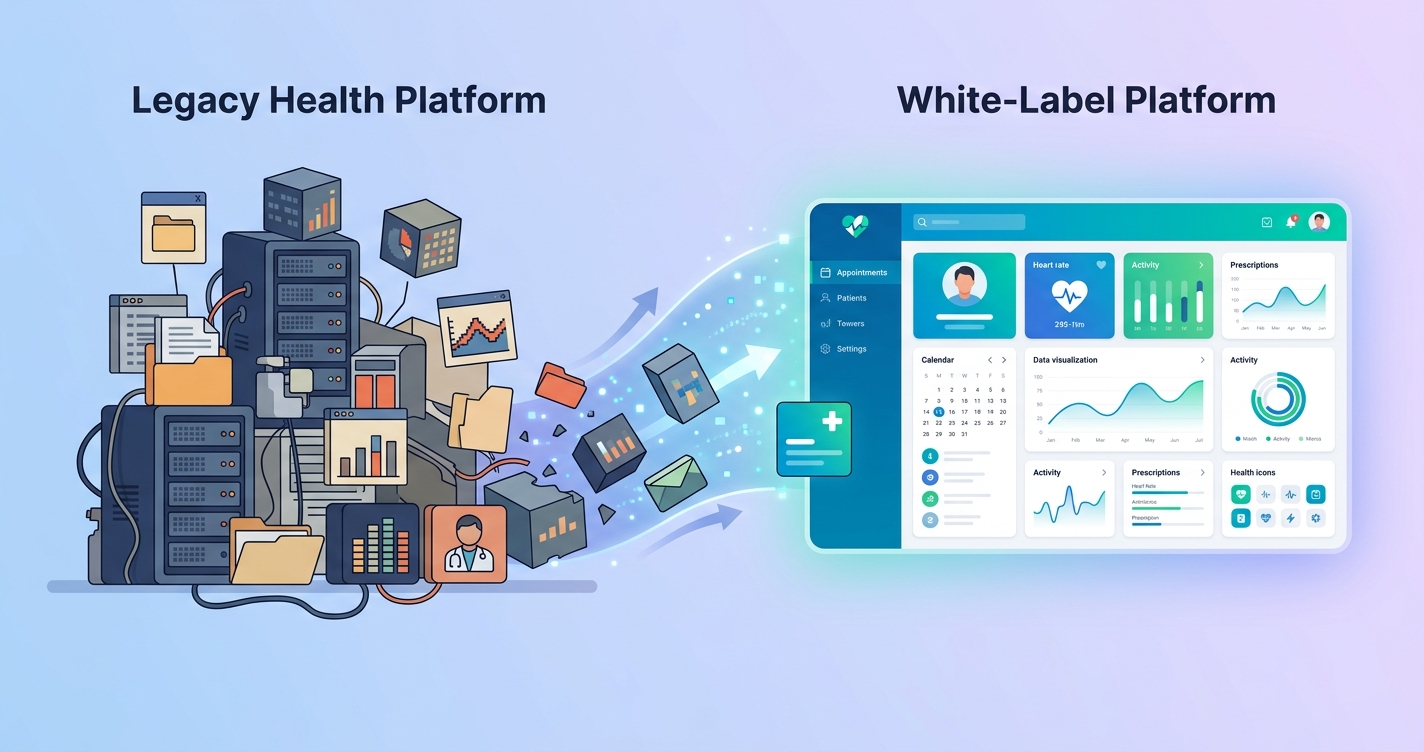
For teams trying to migrate a legacy health platform to white-label infrastructure, the hard part is rarely the contract. It is the handoff between old workflows, brittle integrations, and the new platform that has to carry patient, provider, or member experiences without breaking trust. In 2026, that migration question sits right in the middle of healthcare modernization: not whether legacy systems should be replaced, but how organizations can move without creating a second mess on the way out.
"Technical debt can consume up to 40 percent of IT budgets in large enterprises." — McKinsey, LegacyX: Rejuvenating legacy infrastructure with agentic AI (2025)
Why legacy-to-white-label migration has become a board-level issue
Legacy health platforms stay in production for understandable reasons. They already connect to scheduling systems, EHR records, claims logic, identity tools, and reporting pipelines. The problem is that age turns those integrations into traps. McKinsey wrote in 2025 that technical debt can absorb up to 40% of IT budgets in large enterprises, which is a blunt way of saying that old systems quietly eat money that leadership thought was funding innovation.
KLAS Research found a similar pattern in its Global HIT Trends 2025 report, based on interviews with 174 healthcare organizations across 39 countries. AI, infrastructure, cybersecurity, and interoperability rose together as spending priorities. That matters because migration projects are no longer isolated IT cleanups. They now sit inside a broader modernization push where buyers expect better data flow, stronger governance, and faster deployment at the same time.
White-label platforms appeal to that environment because they shift the work. Instead of rebuilding every service in-house, organizations move toward a platform where the core infrastructure already exists and internal teams focus on branding, workflows, integrations, and operating fit.
| Migration question | Legacy platform reality | White-label migration objective |
|---|---|---|
| Infrastructure ownership | Internal team carries aging code, patches, and dependencies | Vendor maintains core platform infrastructure |
| Release velocity | Changes are slow because regression risk is high | Teams prioritize configuration and integration over net-new rebuilds |
| Compliance burden | Security and audit work is scattered across old modules | Controls are concentrated in a modern platform model |
| Data exchange | Interfaces are often custom and brittle | APIs and standards-based exchange become the migration backbone |
| Time to launch new products | Expansion is limited by engineering backlog | New branded experiences can ship faster once the core move is complete |
That does not make migration simple. It does make the business case easier to defend.
What actually changes when you move to a white-label model
A lot of migration plans fail because teams describe the move as a software replacement. It is bigger than that. A legacy-to-white-label transition usually changes four things at once:
- the operating model for product and engineering
- the data architecture used for patient or member records
- the implementation burden carried by internal teams
- the timeline for launching new branded experiences
CMS made that broader point in its 2025 Interoperability Framework, which described modern health data exchange as open, standards-based, and market-friendly. That language matters here. If the migration target cannot support data movement, identity, and workflow interoperability, then the organization has not modernized much. It has only swapped one closed system for another.
I keep coming back to this distinction because buyers often over-focus on front-end branding. Branding matters. But the real migration test is whether the new platform can absorb the operational complexity that the legacy system used to hold together badly.
The migration sequence that tends to work best
The strongest migrations are usually phased, not dramatic. The goal is not to move every dependency on day one. The goal is to reduce risk while creating a path away from the legacy environment.
1. Separate core business functions from legacy habits
Most teams start with an application inventory. The better teams go one level deeper and ask which workflows actually matter:
- user enrollment and identity
- vitals capture or patient-facing screening flows
- provider review workflows
- reporting and analytics
- consent, audit, and administrative controls
- downstream record exchange
That distinction matters because legacy systems tend to preserve old habits as if they were product requirements. Some workflows are mission-critical. Others only exist because the old platform made cleaner design impossible.
2. Define the interoperability layer before the cutover
CMS's 2025 framework leaned heavily on FHIR APIs and shared credentials because data exchange breaks first when modernization is rushed. That is not abstract policy talk. It is a practical migration warning.
The cutover gets safer when teams define, early, how the white-label platform will handle:
- inbound historical data
- outbound records to EHR or payer systems
- identity and SSO
- event logging and audit trails
- permissions by role and tenant
- data export if the organization changes vendors later
A 2024 Journal of Medical Internet Research systematic mapping review on semantic interoperability using FHIR found that framework and architecture proposals dominated the literature. That sounds academic, but the takeaway is simple: migrations succeed when the data model and exchange layer are designed as first-class architecture, not as cleanup work after launch.
3. Migrate workflows in waves, not all at once
The legacy platform usually contains a few functions that produce most of the operational pain. Those are often the right first candidates for white-label migration: the branded patient experience, dashboards, admin views, or a single service line that needs faster iteration.
A wave-based model gives teams room to:
- validate data movement on a smaller surface area
- train users before enterprise-wide rollout
- measure support load and failure points
- keep the legacy system alive only where it is still needed
That is less exciting than a "big bang" replacement story. It is also how most serious healthcare teams reduce avoidable outages.
Comparison table: common migration approaches
| Approach | Speed | Risk profile | Best fit | Main drawback |
|---|---|---|---|---|
| Full rip-and-replace | Slow | High | Small platforms with limited integrations | Too disruptive for most healthcare environments |
| Parallel run with phased cutover | Moderate | Lower | Hospitals, telehealth vendors, payer programs | Requires temporary duplication of work |
| Front-end replatform first | Faster | Moderate | Teams whose patient or member UX is the top priority | Legacy back-end complexity remains in place |
| Service-line migration | Faster | Lower | Organizations launching a new program or brand | Benefits accrue unevenly across the enterprise |
| Data-layer-first modernization | Slow upfront | Lower long term | Teams with severe interoperability issues | Value may be less visible early on |
For most digital health companies and hospital IT teams, parallel migration with phased cutover looks more realistic than full replacement. It buys time for validation while still creating momentum.
Where migration risk usually shows up
In practice, legacy-to-white-label migration projects do not fail because teams forgot to buy software. They fail because one of the surrounding operating assumptions breaks.
The most common trouble spots are familiar.
- Historical data is incomplete, duplicated, or poorly structured.
- Role permissions in the old system do not map cleanly to the new platform.
- Internal stakeholders assume the vendor will handle process redesign automatically.
- The organization discovers late that downstream partners rely on undocumented exports.
- Security review starts after implementation work is already underway.
This is where the KLAS and CMS signals matter. Buyers are increasingly prioritizing interoperability, cybersecurity, and infrastructure together because they have learned the hard way that these issues travel as a pack.
Industry applications
Telehealth and virtual care platforms
Telehealth software vendors often migrate toward white-label platforms when they need to launch branded workflows quickly without carrying a long infrastructure roadmap in-house. The migration focus here is usually on patient identity, visit flow integration, and data exchange into the existing care record.
Hospital innovation and digital front door programs
Hospital IT teams usually care less about visual branding alone and more about governance, admin control, and phased rollout. Their migrations live or die on whether the white-label platform fits enterprise review processes and can coexist with legacy systems during transition.
Payer and member engagement products
Payer teams often need a migration path that preserves reporting, segmentation, and member-facing consistency while letting them modernize experience layers faster than their core systems can evolve.
Startup and growth-stage digital health companies
For startup operators, migration is often a runway decision. If too much engineering time keeps getting trapped in legacy maintenance, the white-label move becomes less about aesthetics and more about reclaiming product velocity.
Current research and evidence
McKinsey's 2025 analysis of legacy modernization argued that technical debt can consume up to 40% of IT budgets in large enterprises. That number is useful because it reframes migration away from a one-time platform spend and toward the ongoing cost of doing nothing.
KLAS Research reported in 2025 that healthcare organizations across 39 countries were sharply increasing focus on AI, infrastructure, cybersecurity, and interoperability. Legacy migration sits squarely in that intersection. A white-label move is rarely approved because leadership wants a cleaner codebase. It gets approved because the old platform blocks product, security, and integration priorities all at once.
CMS's 2025 Interoperability Framework adds another layer. The agency described modern health data exchange as open, standards-based, and designed to support providers, payers, EHRs, networks, and digital health products. For migration planning, that means the target state should support structured exchange rather than rely on one-off data handoffs.
The 2024 JMIR review on FHIR semantic interoperability makes the architecture point more explicit. Across the mapped literature, framework and architecture proposals were the most common contribution type, which lines up with what migration teams already know from experience: if the information model is weak, the implementation plan will start to wobble no matter how polished the front end looks.
The future of migrating from legacy health platforms
I do not think the market is moving toward a simple "build nothing internally" model. It looks more like selective ownership.
Organizations will keep differentiating where it matters: workflows, clinical logic, reporting, care programs, and customer experience. But they are getting less interested in owning aging core infrastructure just because they inherited it.
That shift makes white-label migration more attractive in three situations:
- when a company needs a new branded launch faster than its legacy stack can support
- when compliance and security work are consuming too much of the engineering roadmap
- when interoperability requirements are growing faster than the old platform can adapt
The teams that handle this well will probably treat migration as portfolio management, not ideology. Keep what genuinely differentiates the business. Move the rest to infrastructure that can evolve faster.
Frequently asked questions
What does it mean to migrate a legacy health platform to white-label?
It usually means replacing parts of an aging in-house or heavily customized platform with licensed infrastructure that supports your brand, workflows, and integrations while shifting core platform maintenance to a vendor.
When is a white-label migration better than rebuilding from scratch?
It tends to be better when speed, capital efficiency, and operational relief matter more than owning every layer of the stack. Teams often choose it when the infrastructure itself is not their main source of differentiation.
What is the biggest risk in a legacy platform migration?
Usually it is not the interface. It is hidden dependency risk: undocumented exports, weak data quality, brittle integrations, and role mappings that only become visible late in the project.
Why does interoperability matter so much in white-label migration?
Because a healthcare platform still has to exchange information with EHRs, payer systems, analytics tools, and identity services after the move. If that layer is weak, the migration just relocates the old problem.
If your team is assessing how to leave an aging platform without rebuilding everything internally, solutions like Circadify Custom Builds are built for that middle ground: branded deployment, configurable workflows, and a cleaner path from legacy infrastructure to production rollout.
Related reading on this site: White-Label vs Build From Scratch: Cost and Timeline Compared, How to Evaluate White-Label Health Technology Partners, and What Is Multi-Tenant Architecture? Health Monitoring Platforms Explained.