
How RPM Companies Launch Branded Remote Monitoring Portals in 2026
A research-backed look at branded remote patient monitoring portal launch strategy in 2026, covering rollout models, interoperability, reimbursement, and adoption risk.
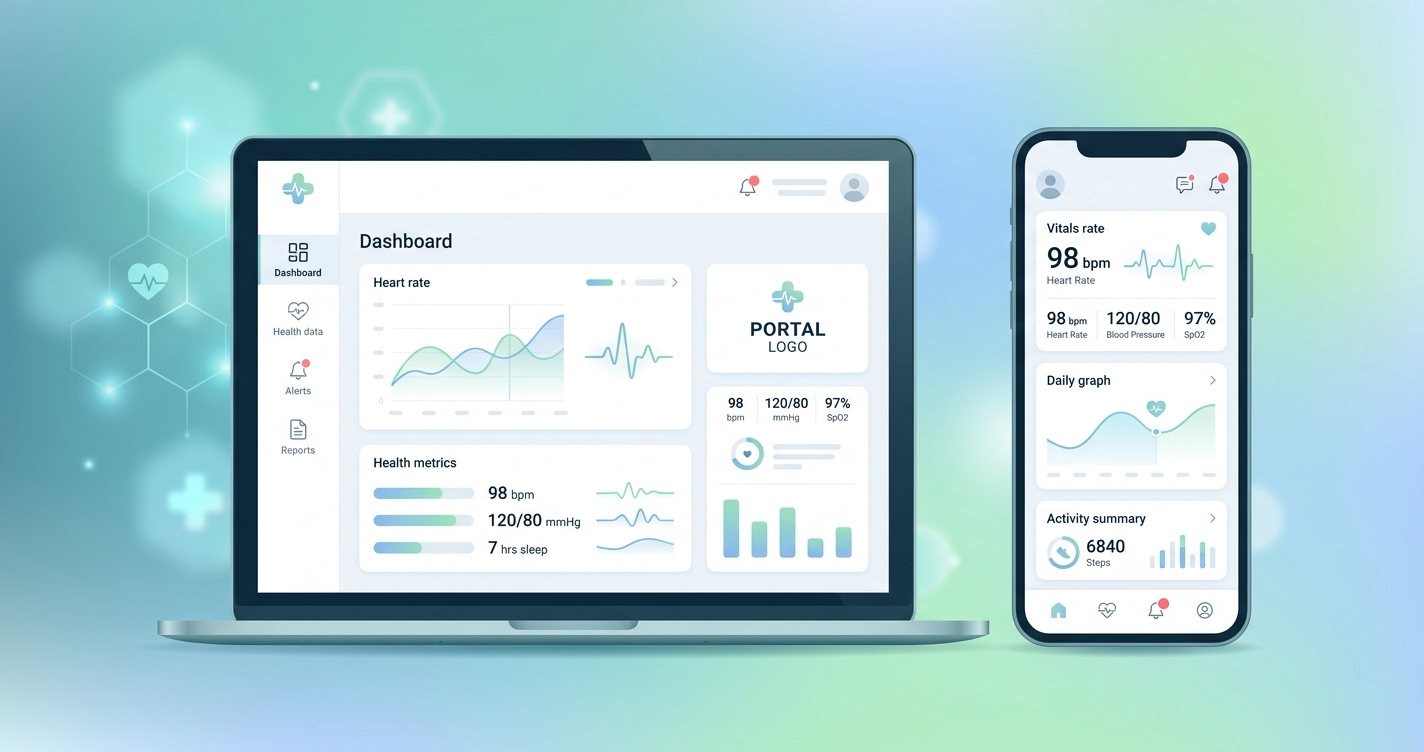
A branded remote patient monitoring portal launch is no longer just a design exercise. In 2026, RPM companies are being judged on whether the portal can support reimbursement, fit into clinical workflows, and keep patients engaged after the first login. For digital health founders, telehealth platform product managers, and hospital IT teams, the launch question has become pretty blunt: can this branded experience work like a real operating layer, or is it just a nicer wrapper around disconnected tools?
"RPM interventions demonstrated positive outcomes in patient safety and adherence, with a clear downward trend in hospital admission and readmission risk." — S. Y. Tan, J. Sumner, Y. Wang, and A. Wenjun Yip, npj Digital Medicine (2024)
Branded remote patient monitoring portal launch: what actually gets launched
When RPM companies talk about launching a portal, they usually mean four things at once:
- a patient-facing login and enrollment experience
- a branded workflow for vitals capture, reminders, and follow-up
- a data layer that routes readings into care management systems
- an operational console for staff, reimbursement, and exception handling
That mix matters because the portal is not the product by itself. It is the front door into a much larger workflow. A 2024 systematic review in npj Digital Medicine led by Si Ying Tan found that RPM programs were associated with better adherence and lower admission or readmission risk across 29 studies. The practical takeaway is simple: launch quality matters because patient engagement and workflow reliability are tied to outcomes, not just presentation.
The portal market is getting more serious for the same reason. HHS's health IT guidance still treats patient portals as a core access point for records, communication, and participation in care. CMS, meanwhile, continues to reimburse RPM through CPT codes 99453, 99454, 99457, and 99458, so platform operators have a financial reason to make enrollment, data review, and documentation less messy.
| Launch layer | What buyers expect in 2026 | What slows launches down |
|---|---|---|
| Patient experience | Branded onboarding, clear consent, mobile-friendly workflows, reminder logic | Too many steps, weak activation, confusing device or camera setup |
| Clinical workflow | Threshold rules, inboxes, escalation paths, documentation support | Alert noise, unclear ownership, manual review burdens |
| Data and integration | APIs, EHR or care-management connections, export paths, audit logs | Custom integrations, identity mismatches, weak data mapping |
| Business operations | RPM billing support, tenant controls, analytics, reporting | Fragmented dashboards, inconsistent utilization tracking |
I keep coming back to that last point. Buyers say they want branding, but they usually sign when the operating model looks believable.
Why portal launches now start with workflow, not design
A few years ago, RPM portal discussions often started with the interface: logo placement, colors, maybe the messaging tone. In 2026, teams still care about that, but the harder questions come first.
Can the portal enroll patients without staff hand-holding? Can readings move into the right queue? Can the clinical team decide what counts as actionable? Can finance document enough activity to support reimbursement? Those are launch questions now.
That shift lines up with the broader patient-portal evidence base. In their updated 2021 systematic literature review in JMIR Medical Informatics, Elena Carini and colleagues found that patient portals tend to improve convenience, communication, and patient involvement, but results depend heavily on usability, integration, and actual adoption by both patients and clinicians. A portal can exist on paper and still fail in practice.
For RPM operators, that leads to a more realistic launch sequence:
- define the monitoring population first
- map what data needs review and by whom
- decide how exceptions escalate
- build the portal around those decisions
That is less exciting than starting with a polished mockup, but it is usually the difference between a launch and a login page.
The operating model behind a successful branded portal launch
Most RPM companies launching branded portals in 2026 follow one of three operating patterns.
1. Payer or employer-branded engagement layer
In this model, the portal is a member-facing front end for screening, monitoring, reminders, and outreach. The brand matters because trust and continuity matter. The challenge is that these launches often require tenant separation, benefit-specific workflows, and reporting that can roll up at the program level.
2. Provider-led RPM workflow layer
This version is closer to care operations. The portal supports enrollment, vitals collection, messaging, and escalations tied to nurse or care-management teams. Launch risk usually centers on staffing logic, threshold design, and EHR handoff.
3. White-label platform extension for digital health companies
Here the portal is part of a broader branded product stack. The buyer wants speed to market but still needs enough configuration control to make the product feel like its own. These launches live or die on identity, APIs, analytics, and brand controls rather than feature volume alone.
| Launch model | Primary buyer | Main success metric | Common failure mode |
|---|---|---|---|
| Payer or employer branded portal | Health plans, benefits teams, large employers | Activation and recurring member use | Portal looks branded but workflows stay generic |
| Provider-led RPM portal | Clinics, health systems, virtual care groups | Staff efficiency and documented intervention time | Alert routing and documentation stay manual |
| White-label digital health portal | Startups, telehealth platforms, platform teams | Speed to market with operational control | Too much custom work for each deployment |
Industry applications
Telehealth platforms adding monitoring without rebuilding their stack
This is one of the clearest 2026 use cases. A telehealth company already has visits, messaging, and scheduling. What it lacks is a branded layer for repeated vitals collection between visits. A portal launch works when RPM becomes part of the same patient journey instead of a separate program patients have to remember.
Hospital outpatient and specialty programs
Specialty programs often want a branded portal for post-discharge follow-up, hypertension monitoring, cardiometabolic support, or maternal health outreach. Here the launch is less about marketing and more about reducing operational drag. If escalation paths are unclear, the portal creates more work than it removes.
Payers building member-facing digital health programs
Payers care about engagement, but they also care about whether the reporting is solid enough to justify expansion. Branded portals help keep the experience inside the payer's ecosystem, though only if enrollment and retention are simple enough for members to keep using.
Current research and evidence
The evidence around RPM launch strategy is scattered across clinical, operational, and policy sources, but the pattern is fairly consistent.
Tan, Sumner, Wang, and Wenjun Yip reported in npj Digital Medicine in 2024 that RPM interventions showed positive effects on safety and adherence and were associated with lower hospitalization-related utilization. That does not tell an RPM company exactly how to launch a portal, but it does explain why getting adoption right matters.
Carini and colleagues, writing in Journal of Medical Internet Research in 2021, found that patient portals can improve patient engagement and system efficiency when implementation is usable and integrated into care processes. Again, the lesson is not "build more features." It is "make the workflow real."
CMS policy remains part of the launch equation too. RPM billing still depends on consistent setup, device or monitoring workflows, and clinician time documentation under the established RPM code family. In other words, reimbursement pushes platform design toward traceable operations.
HHS guidance on patient portals adds another layer: patients increasingly expect digital access, messaging, and visibility into care information through a single account. For branded RPM portals, that means the portal has to feel coherent. If monitoring sits off to the side as a separate experience, adoption drops.
| Source | Key finding | Why it matters for portal launches |
|---|---|---|
| Tan et al., npj Digital Medicine (2024) | RPM interventions improved adherence and showed a downward trend in admissions and readmissions | Reliable patient participation is central to program value |
| Carini et al., JMIR (2021) | Patient portals can improve engagement and efficiency, but implementation quality matters | Branded UX alone does not guarantee use |
| CMS RPM coding framework | Reimbursement is tied to setup, monitoring, and interactive management activities | Portal workflows need documentation and operational clarity |
| HHS patient portal guidance | Patients use portals for access, communication, and involvement in care | RPM portals work best when they feel like the main digital front door |
The future of branded remote monitoring portals
I do not think RPM portal launches are getting simpler. They are getting less forgiving.
The next wave looks like this:
- more portals tied to specific buyer segments instead of generic patient dashboards
- more emphasis on identity, tenant controls, and analytics from day one
- stronger integration with care-management and reimbursement workflows
- lighter onboarding paths, especially for smartphone-based measurement and follow-up
The interesting part is that branding still matters. It just matters in a narrower way than people assume. A branded portal earns its keep when it creates trust and continuity without adding friction. If it adds friction, the brand does not save it.
Frequently asked questions
What is a branded remote patient monitoring portal?
It is a patient-facing RPM experience presented under the buyer's own brand, usually with custom identity, messaging, enrollment flows, and reporting. In practice, it also needs staff workflows behind the scenes.
Why are RPM companies launching branded portals in 2026?
Because buyers want a digital health experience that feels native to their organization while still supporting monitoring, communication, and reimbursement operations. White-label infrastructure makes that possible without a full custom build.
What usually delays an RPM portal launch?
Integration work, unclear escalation rules, identity setup, and messy enrollment logic cause more delays than visual branding. Teams often underestimate how much operational design sits behind a clean patient portal.
Does a branded portal improve patient engagement on its own?
Not by itself. Research on patient portals and RPM suggests engagement improves when the workflow is simple, the value is clear, and the portal is tied to actual care processes rather than treated as a disconnected app.
If your team is planning a branded RPM rollout, solutions like Circadify Custom Builds are designed for organizations that want a white-label launch path without rebuilding the whole platform stack.
Related reading on this site: How Payers Build Member Health Portals With White-Label Tech, Hospital White-Label Remote Monitoring: What IT Teams Need to Evaluate, and White-Label Health Monitoring Explained.