
How Payers Build Member Health Portals With White-Label Tech
A research-backed look at how payers build member health portals with white-label tech, from FHIR data access and UX design to governance, rollout, and retention goals.
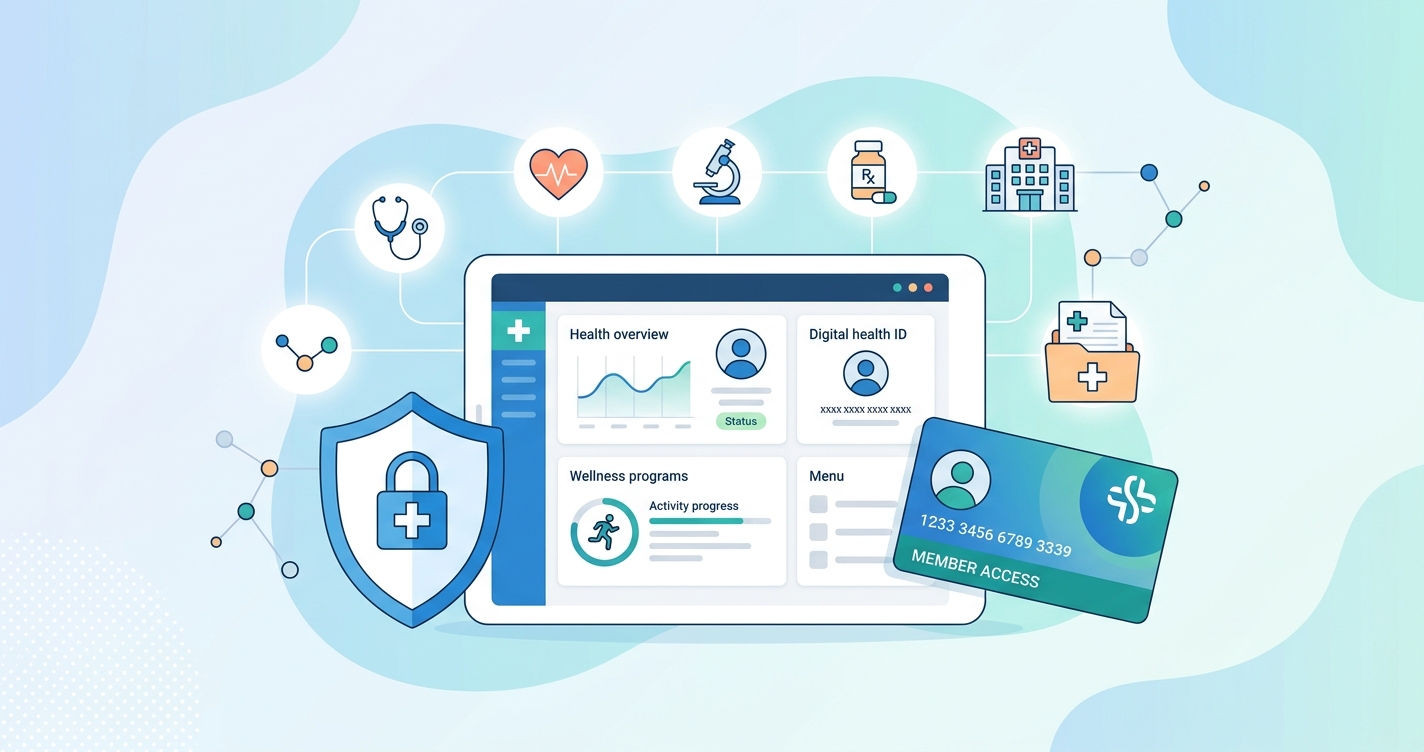
The market for a payer member health portal white label technology stack is getting crowded for a simple reason: health plans now need a better digital front door, but very few want to build every portal component from scratch. Member expectations have been shaped by banking, retail, and consumer apps, while regulatory pressure keeps pushing payers toward better data access and interoperability. That combination changes the build decision. For many plans, the question is no longer whether a portal matters. It is whether the portal can be launched fast enough, integrated cleanly enough, and governed well enough to earn repeat use.
"When members can find the health plan information they need, overall member satisfaction rises 83 points." — Sara Heath summarizing J.D. Power's 2025 U.S. Healthcare Digital Experience Study in TechTarget
Payer member health portal white label technology: what payers are really buying
A member portal sounds like one product. In practice, it is a bundle of functions that sit across eligibility, benefits, claims visibility, provider search, communications, and increasingly health data access.
That is why white-label technology has become attractive. A payer can control the brand, workflow, and member experience without taking on the full cost and delay of building the entire application layer internally. The better white-label model is not a generic portal template with a logo swap. It is a configurable platform that can adapt to plan rules, lines of business, data sources, and compliance requirements.
Here is the part that gets lost in vendor demos: member portals fail less often because of weak design than because of weak operating fit. If data is incomplete, if provider directories are stale, if claims views are hard to parse, or if security review starts too late, the portal becomes another underused channel.
Payers usually evaluate white-label portal technology across five layers:
- member identity, authentication, and access controls
- claims, encounter, and clinical data availability
- provider directory and plan network search
- communications, alerts, and service workflows
- analytics, governance, and rollout operations
| Portal layer | What the member sees | What the payer has to solve underneath | Why white-label matters |
|---|---|---|---|
| Identity and access | Login, MFA, account recovery, household permissions | IAM, role logic, consent, security review | Faster launch without rebuilding the auth layer |
| Benefits and claims view | Coverage details, deductibles, EOB-style information | Claims normalization, terminology, refresh timing | Lets plans ship branded experiences on top of existing payer data |
| Clinical and interoperability layer | Lab results, care summaries, app connectivity | FHIR APIs, USCDI mapping, API governance | Helps plans comply with access rules while keeping the portal cohesive |
| Provider and network search | In-network lookup, plan directory, filters | Directory accuracy, network data model, search performance | Reuses infrastructure that is expensive to build well |
| Service workflows | Messages, reminders, navigation, digital support | Routing rules, escalation logic, content operations | Supports member journeys without custom coding every flow |
That table gets to the real issue. A portal is only as good as the systems feeding it.
Why interoperability now sits at the center of portal strategy
CMS has spent the past several years pushing payers toward API-based access. Its Patient Access API guidance says impacted payers must make claims, encounter, and clinical data they maintain available through a FHIR-based API. The 2024 CMS interoperability final rule also expanded expectations around prior authorization APIs and payer-to-payer exchange. That matters because the portal is no longer just a web destination. It is becoming one presentation layer in a broader data-access architecture.
This is where white-label decisions get more strategic. A modern member portal cannot just render static plan content. It has to sit on top of data pipelines that are usable across web, mobile, and third-party apps.
HL7's Da Vinci PDex Plan-Net implementation guide makes the provider-directory side of this clearer. The guide defines a FHIR interface for a health insurer's plans, networks, organizations, and participating providers so third parties can query a payer's network data in a standardized way. For portal teams, that means better directory architecture is not a side project. It is basic product infrastructure.
A few practical design implications follow from that:
- the portal should be treated as a front end to interoperable services, not as an isolated application
- claims and clinical data models need governance before UX polish
- provider search has to be designed around data quality, not just filters and map views
- API readiness affects both compliance work and future consumer features
I think this is where a lot of internal portal roadmaps go sideways. Teams start with screens and navigation, then discover late in the process that the underlying data is fragmented across vendors, business units, and legacy systems. White-label technology is useful only if it reduces that integration burden rather than hiding it.
What member behavior says about the portal experience
Health plans have more reason than ever to care about digital execution. The 2025 J.D. Power study, as reported by TechTarget, found commercial-plan digital experience scored 653 out of 1,000 and Medicare Advantage app satisfaction scored 597. The same reporting noted that app use rose to 37% in 2025 from 31% in 2024. So usage is growing, but satisfaction still looks mediocre.
That is a revealing combination. Members are showing up because digital access is now expected. They are not necessarily staying because the experience is good.
The same report said plans missed the mark on digital experience nearly 39% of the time when members were trying to find needed information. For portal builders, that is not a cosmetic issue. It means the product is failing at the exact moment when members are looking for plan value, benefits clarity, cost detail, or next steps.
The EBRI and Greenwald Research Consumer Engagement in Health Care Survey, fielded in late 2025 and published in early 2026, reinforces the point from another angle. The survey focused on how insured adults navigate plan choice, satisfaction, health technology, and emerging digital tools. That kind of consumer research matters because portal adoption is not just a technology problem. It is a trust and comprehension problem too. Members use digital channels when those channels help them understand coverage and make decisions with less friction.
How payers typically build with white-label technology
The strongest portal programs usually do not begin with a giant rebuild. They start with a narrower operating model.
1. Start with the jobs members already show up to do
Most member portals are not judged on ambition. They are judged on whether members can log in, find benefits, check claims, confirm network status, and understand what to do next. The J.D. Power findings are a good reminder that searchability and clarity often matter more than flashy features.
That usually pushes plans toward a phased rollout:
- launch core account access and benefits navigation first
- add claims and spending views with plainer explanations
- layer in provider search and care-navigation workflows
- expose API-connected health data and partner experiences over time
2. Use configuration instead of custom code where possible
A white-label portal should let plans control branding, navigation, content blocks, member segments, language, and workflow rules without rewriting the product each time a business unit changes requirements. If every portal variation requires engineering work, the payer has not really bought leverage.
The better platforms support:
- configurable page modules
- tenant-level benefit and workflow logic
- role-based content and messaging
- reusable integration patterns for claims, APIs, and directories
- analytics dashboards tied to engagement and conversion events
3. Put governance in the build, not after it
This point sounds boring, but it keeps showing up for a reason. Portal teams that defer governance usually end up with inconsistent data definitions, weak release control, and member communications that drift away from compliance expectations.
For payers, governance usually means:
- clear owners for claims, clinical, and directory data
- release approval for member-facing content changes
- audit trails for configuration changes
- privacy and consent controls tied to specific workflows
- vendor management for any third-party modules in the portal stack
Current research and evidence
The evidence base on portals is helpful here, even though much of it comes from provider-facing or patient-facing settings rather than payer-only studies.
In their updated systematic review in the Journal of Medical Internet Research, Anna Ammenwerth and colleagues examined 47 studies of digital patient portals. They found favorable evidence for health outcomes in several settings, especially around improved monitoring, better patient-clinician interaction, and stronger awareness of health status. They also reported mixed results on utilization and efficiency, while noting common barriers such as privacy concerns and limited time. That is a useful reality check for payers. A portal can create value, but value does not appear automatically once the login page goes live.
CMS provides the regulatory backbone. Its Patient Access API FAQ states that impacted payers must make the claims, encounter, and clinical data they maintain available through a FHIR-based API. The 2024 final rule on advancing interoperability pushed that direction further by reinforcing API-based exchange and tighter expectations for data movement among payers and related stakeholders.
HL7's Da Vinci PDex Plan-Net guide covers another pain point that members feel immediately: directory accuracy. The guide describes a FHIR interface for plans, networks, organizations, and providers so applications can query network participants in a standardized way. In portal terms, that means member-facing search depends on structured network data, not just a better front-end search bar.
| Source | Key finding | What it means for portal strategy |
|---|---|---|
| Ammenwerth et al., JMIR systematic review | 47 studies reviewed; favorable evidence on some health outcomes, mixed evidence on efficiency; privacy and time were common barriers | Portals need workflow value, not just availability |
| CMS Patient Access API FAQ | Impacted payers must make claims, encounter, and maintained clinical data available via FHIR-based APIs | Portal architecture has to align with interoperable data access |
| CMS 2024 interoperability final rule | API-based exchange expectations continue to expand across payer workflows | Member portals should be built as part of a broader interoperability stack |
| HL7 Da Vinci PDex Plan-Net | Standardized FHIR interface for plans, networks, organizations, and providers | Provider search and network discovery need structured directory infrastructure |
| J.D. Power 2025 study reported by TechTarget | Commercial digital experience scored 653/1000; MA app satisfaction 597; app use rose from 31% to 37% | Usage is rising, but member experience still has a lot of room to improve |
Industry applications
Commercial payer member portals
Commercial plans usually care about reducing service friction. That means better benefit explanations, cleaner cost views, smarter provider search, and easier navigation into wellness or care-management programs. White-label technology helps if it shortens launch cycles without breaking core administration systems.
Medicare Advantage experiences
Medicare Advantage portals have a different pressure profile. Renewal risk is higher, navigation needs are often broader, and app usability matters a lot. J.D. Power's lower Medicare Advantage app score suggests that many plans still have a gap between what members need and what current digital tools deliver.
Employer-sponsored plan experiences
For plans sold through employers, the portal often becomes a quiet part of employer satisfaction. Members do not separate the plan from the broader benefits experience as neatly as internal teams do. If they cannot understand spending, claims, or covered options, the portal damages the relationship fast.
White-label partner ecosystems
Some plans also need the portal to connect with navigation vendors, telehealth services, wellness programs, or remote monitoring experiences without turning each relationship into a custom software project. That is one of the better arguments for a configurable white-label stack. It gives the payer a unified brand layer while keeping room for partner integrations behind it.
The future of payer member portals
I do not think the next generation of payer portals will win on feature count alone. They will win on coherence.
Members want one place that makes coverage easier to understand, not five disconnected experiences with different logins and different definitions of the same benefit. Regulators want cleaner access to data. Portal teams want faster release cycles without inheriting a permanent custom-development burden. Those pressures all point in the same direction: configurable portal platforms sitting on top of stronger APIs, cleaner data governance, and more disciplined workflow design.
That future still leaves room for judgment. Not every plan should replace everything at once. But the plans moving first usually share one assumption: the member portal is no longer a side channel. It is part of the operating model.
Frequently asked questions
What is white-label technology in a payer member portal?
It is a portal platform a health plan can brand and configure as its own while relying on a shared technology base for functions like login, content modules, integrations, and workflow management.
Why are payers using white-label portal technology instead of building from scratch?
Mostly because building internally is slow and expensive when the portal also needs claims access, provider search, API integration, governance controls, and cross-channel support. White-label platforms can shorten time to launch if they are configurable enough.
What data should a modern payer member portal connect to?
At minimum, plans usually need benefits, claims or encounters, provider network data, and the clinical data they maintain. Increasingly they also need FHIR-based API support so the portal fits broader interoperability requirements.
What makes members keep using a health plan portal?
Clear information, fast login, useful provider search, understandable spending details, and fewer dead ends. The strongest predictor is often simple: can the member find what they came for without giving up.
If your team is planning a branded member portal and wants a faster route than building every workflow in-house, solutions like Circadify Custom Builds give health companies a way to launch configurable digital experiences on a white-label foundation.
Related reading on this site: How to Evaluate White-Label Health Technology Partners, How Telehealth Platforms Add Vitals Without Building In-House, and What Is Multi-Tenant Architecture? Health Monitoring Platforms Explained.