
Health Monitoring Partner Program: How to Resell White-Label Tech
A research-backed analysis of how to structure a resell white label health monitoring partner program, from margin design and buyer fit to deployment and compliance readiness.
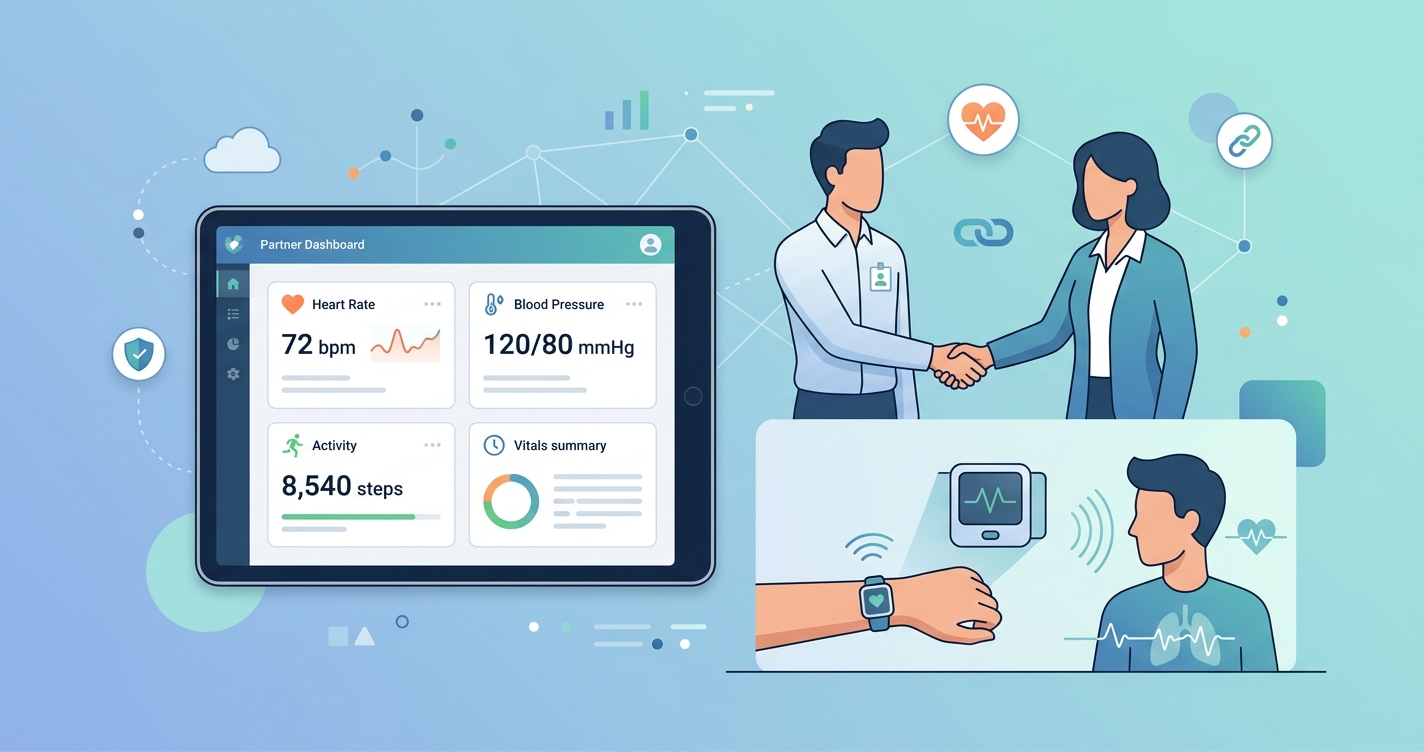
The market for remote patient monitoring and virtual care infrastructure keeps getting bigger, but that does not mean every company should build its own stack. For many software firms, consultants, telehealth operators, and regional integrators, the more practical question is whether a resell white label health monitoring partner program can create a faster route to revenue than custom development. In 2026, that question is less about flashy product claims and more about distribution math: who owns the customer, who handles deployment, how margins work, and what level of branding and workflow control the partner actually gets.
"The companies that win in digital health will not be the ones that build every layer themselves. They will be the ones that combine trusted infrastructure with strong distribution and workflow fit." — Deloitte, Future of Health 2040
Resell white label health monitoring partner program: what it actually means
A health monitoring partner program is a commercial model in which one company provides the underlying monitoring technology and another company resells or deploys it under its own brand, service wrapper, or customer relationship. In practice, the partner may be a telehealth vendor, a healthcare IT consultancy, a payer-adjacent platform, a regional systems integrator, or a digital health startup that wants a branded offer without a ground-up build.
The key distinction is this: a reseller partner program is not just a referral relationship. The partner usually takes on some mix of branding, packaging, customer onboarding, workflow design, first-line support, or account management.
That matters because health technology deals rarely close on feature lists alone. Buyers want someone who can adapt the product to a workflow they already understand.
| Partner model | What the partner does | Revenue model | Best fit | Main constraint |
|---|---|---|---|---|
| Referral partner | Introduces leads only | Referral fee or revenue share | Consultants, agencies, ecosystem partners | Little control over customer experience |
| Reseller partner | Sells the platform under vendor pricing rules | Margin on license or recurring revenue share | Regional health IT firms, solution providers | Depends on vendor packaging and enablement |
| White-label reseller | Sells under partner brand with configured workflows | Higher margin, setup fees, recurring software revenue | Digital health startups, telehealth platforms, specialized operators | Requires stronger onboarding and support capability |
| OEM / embedded partner | Embeds tech into its own product stack | Contracted platform fee or usage economics | Mature software vendors, large health platforms | Longer integration cycle and deeper technical obligations |
The appeal of the white-label reseller model is pretty simple. It lets a company sell a finished category faster than it could build one, while still keeping enough control over branding and customer experience to look like a real platform owner.
Why partner programs are getting more attention in digital health
This is partly a market-timing issue. Rock Health reported that U.S. digital health funding reached $14.2 billion in 2025, but deal volume remained selective and average deal size rose. That is not an environment that rewards long infrastructure detours. It rewards teams that can package, launch, and prove demand.
It is also a channel issue. Alexander Group's 2025 research on healthcare go-to-market performance found that hospital buyers rely on a wider mix of digital information, post-sales support, and implementation proof than they did a few years ago. In other words, distribution is no longer just top-of-funnel lead generation. Buyers want evidence that a platform can be sold, deployed, and supported by someone who understands their setting.
For health monitoring specifically, partner programs make sense because the category sits at the intersection of several buyer groups:
- telehealth and virtual care platforms
- health systems and hospital innovation teams
- employer health and benefits programs
- payer and underwriting workflows
- consultants and service providers building packaged offers
Not all of those buyers want to become full platform developers. Many want a commercial route that lets them own the account and the brand while relying on proven infrastructure underneath.
What separates a workable partner program from a weak one
A lot of so-called partner programs are really just referral forms with nicer branding. That is not enough in health monitoring.
A workable program usually has five operating pieces:
- clear margin structure for recurring software revenue
- branding rights and customer-facing packaging rules
- implementation playbooks for onboarding and workflow setup
- compliance and data-handling language that can survive procurement review
- support boundaries so customers know who handles what
Here is where teams often get tripped up: they focus on commissions before they understand delivery ownership.
If the partner wants to resell white-label health monitoring technology successfully, the partner needs answers to practical questions early:
- Can we price the solution ourselves?
- Do we control the contract, or does the vendor?
- Can we package services around deployment and analytics?
- Who owns first-line support?
- Can the buyer see the underlying vendor, or is the experience fully branded?
- What data portability and integration options are available later?
Those questions sound operational because they are. They are also where channel programs either become durable revenue motions or fall apart after two pilot deals.
Current research and evidence
The underlying economics for partner-led distribution are not unique to health monitoring, but digital health has its own version of the rule: infrastructure is expensive, workflows are local, and distribution trust matters.
Rock Health's 2025 market data described a funding environment where fewer companies captured more capital. That tends to favor models that shorten time to market and reduce duplicated engineering work.
CB Insights made a similar point in its 2025 Digital Health 50 analysis, which evaluated more than 12,000 companies using business relationships, market traction, investor quality, and operational signals. The pattern is hard to miss. The companies getting attention are not merely building novel tools. They are showing that those tools can be sold and adopted inside real organizations.
On the care-delivery side, Anne-Jet S. Jansen and colleagues reported in npj Digital Medicine in 2025 that 72% of the 116 randomized controlled trials in their systematic review found reduced hospital service use from device-based remote monitoring. What I keep coming back to in that review is not just the topline number. The stronger outcomes were associated with actual care redesign, named clinical teams, patient transmission workflows, and support structures. Technology by itself was not the story. Delivery was.
That point matters for reseller programs. A white-label partner can translate generic monitoring infrastructure into a workflow a buyer will actually adopt.
| Source | Key finding | Partner-program implication |
|---|---|---|
| Rock Health (2025) | U.S. digital health funding reached $14.2B while deal count stayed selective | Faster, lower-capital go-to-market models look more attractive |
| Alexander Group (2025) | Healthcare commercial teams are under pressure to improve digital proof, onboarding, and post-sales execution | Partners need enablement, not just commission schedules |
| CB Insights Digital Health 50 (2025) | Market traction and partnerships remain core signals of category winners | Distribution relationships are part of defensibility |
| Jansen et al., npj Digital Medicine (2025) | 72% of 116 RCTs reported lower hospital service use from remote monitoring interventions | Workflow deployment quality matters as much as the technology layer |
| Grand View Research (2025) | Remote patient monitoring market forecasts continue to show strong multiyear growth | There is room for specialized resellers serving distinct buyer segments |
Industry applications
Telehealth platforms
Telehealth vendors often want to add monitoring without becoming monitoring companies. A white-label partner program gives them a way to package branded vitals capture, patient check-ins, or follow-up monitoring inside an existing care experience. The real value is not just the widget. It is the ability to sell a larger platform story.
Regional healthcare IT firms
Many regional implementers already have customer trust, procurement familiarity, and service teams. What they may not have is proprietary monitoring infrastructure. A reseller model lets them add a higher-value product line without standing up a new engineering program.
Employer and benefits solution providers
Benefits platforms and wellness operators often need configurable, branded experiences across multiple client groups. White-label resale works well when the buyer expects one face to the relationship and does not want to juggle multiple point vendors.
Specialized digital health startups
Some startups are strong in one narrow workflow: cardiometabolic coaching, postpartum care, virtual triage, underwriting intake, or chronic care coordination. They can use partner programs to bring monitoring to market under their own brand while keeping their real differentiation in protocol design, engagement, and distribution.
How to design the commercial model
The best partner programs usually balance software margin with services margin.
That balance matters because a pure software resale model can look thin if the vendor controls pricing tightly. A better program often gives the partner room to make money in three places:
- initial setup and workflow configuration
- recurring software margin or revenue share
- optional support, analytics, training, or integration services
A practical comparison looks like this:
| Commercial element | Low-maturity program | Mature partner program |
|---|---|---|
| Pricing flexibility | Fixed list price, minimal margin control | Defined discount tiers or protected margin bands |
| Branding rights | Co-branded at best | Full white-label or near-white-label packaging |
| Services attach | Undefined | Encouraged with documented implementation scope |
| Sales enablement | Basic deck and logo sheet | Demo environment, messaging, onboarding assets, objection handling |
| Support model | Vendor owns everything | Tiered support with clear first-line and escalation rules |
| Expansion path | Referral-only upsell | Resell to white-label to OEM path over time |
This is where founders and channel leaders should be honest with themselves. If the goal is only a quick commission stream, a referral program may be enough. If the goal is to build a partner-led business line, the partner needs room to own more of the customer journey.
The operational checkpoints buyers will still care about
Even in a reseller arrangement, enterprise buyers are still going to ask the same hard questions:
- Where is data stored?
- What does the deployment model look like?
- How are permissions, audit trails, and access controls handled?
- Can the product integrate with existing systems?
- What happens if the customer grows into a more customized model?
That is why the strongest health monitoring partner programs do not stop at sales collateral. They include implementation documentation, sample security responses, escalation paths, and realistic statements about what is configurable today versus what requires deeper custom work.
And yes, this is the boring part. It is also the part that gets contracts signed.
The future of health monitoring partner programs
I do not think the market is moving toward one giant partner template. It is moving toward tiered models.
Some partners will want a referral route. Some will want a branded resale offer. Some will start with white-label and eventually ask for an embedded or OEM relationship. The vendors that handle this well will treat partner programs as maturity ladders, not one-size-fits-all contracts.
I also expect more specialization. A general-purpose reseller program is useful, but niche distribution partners usually win faster because they already understand the buyer's workflow. A telehealth platform operator, an underwriting systems vendor, and a rural health implementation firm are all selling into very different conversations. The infrastructure may be similar. The packaging will not be.
That is the real lesson here. A health monitoring partner program works when it combines proven technology with a partner who knows exactly where the product fits and how to sell it credibly.
Frequently asked questions
What is a health monitoring partner program?
It is a commercial arrangement in which a company sells, deploys, or packages health monitoring technology from another provider. In a white-label version, the partner can usually present the solution under its own brand.
Who should consider a resell white label health monitoring partner program?
Telehealth platforms, healthcare IT consultancies, digital health startups, employer health vendors, and regional integrators are common fits. The model works best for organizations with buyer access and workflow expertise but without a desire to build full monitoring infrastructure in-house.
How is a reseller model different from a referral model?
A referral model mainly passes leads to the vendor in exchange for a fee. A reseller model gives the partner a more active role in pricing, packaging, onboarding, account management, or support.
What matters most when evaluating a white-label partner program?
Look closely at margin structure, branding control, support boundaries, compliance documentation, data ownership, and the path to deeper customization. Those factors affect long-term viability more than headline commission percentages.
If your team wants to launch under its own brand instead of starting from scratch, solutions like Circadify Custom Builds can support a partner-led route to market with white-label deployment flexibility.
Related reading on this site: What Is White-Label Health Monitoring? Platform Options Explained, White-Label vs Build From Scratch: Cost and Timeline Compared, and How Digital Health Startups Go to Market Faster With White-Label.