
How can I quickly see if my exercise is really improving my heart health?
How an exercise heart health tracker built on contactless vitals gives fitness and wellness platforms instant, tangible feedback on cardiovascular progress.
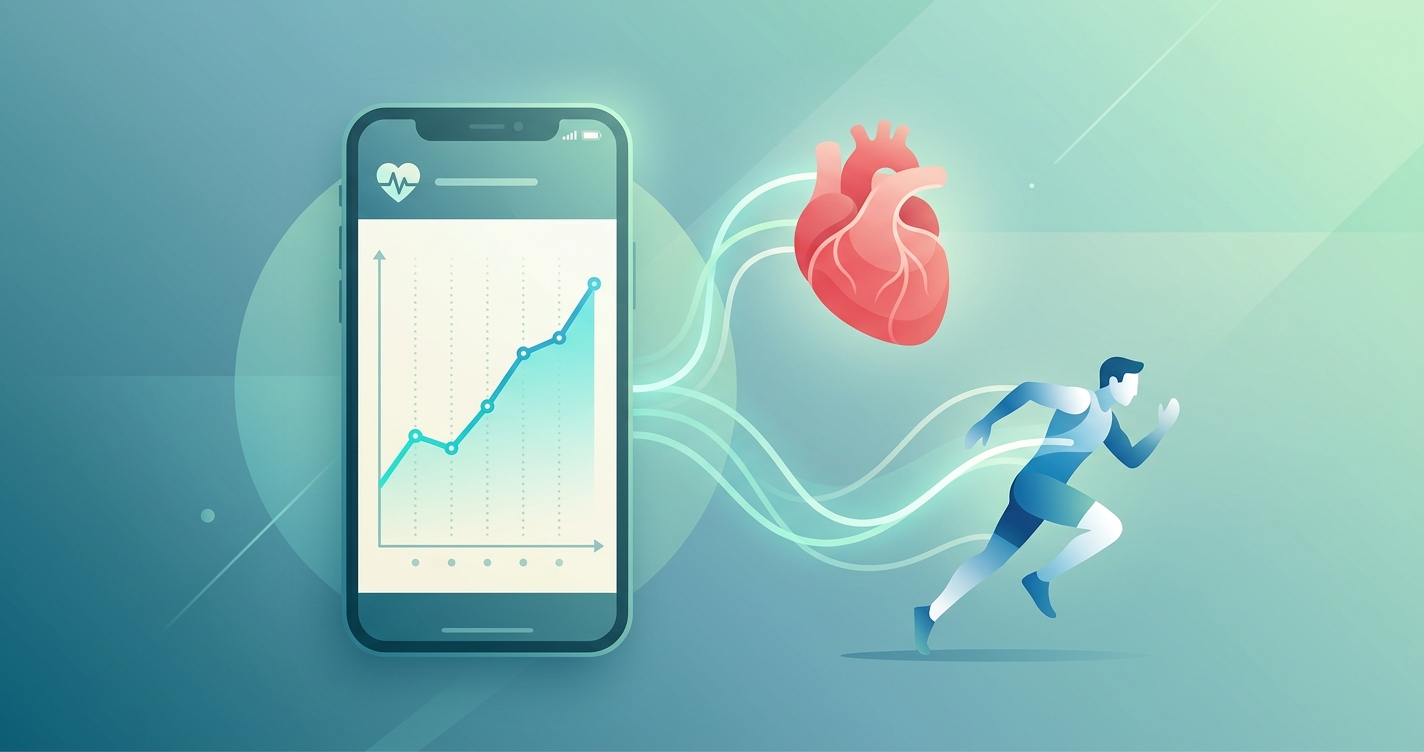
People who change their habits want proof, and they want it fast. When someone commits to walking every morning or adding two strength sessions a week, the first question they ask is not whether the science is sound. It is whether their heart is actually responding. For fitness and wellness platforms, that impatience is a product opportunity. An exercise heart health tracker that turns abstract effort into visible cardiovascular signals is one of the strongest retention tools a digital health company can offer, and it no longer requires a chest strap, a clinic, or a shipped device.
A 2022 overview of meta-analyses spanning more than 20.9 million observations across 199 cohort studies found that cardiorespiratory fitness is one of the most consistent predictors of morbidity and all-cause mortality in adults. Source: Han, Marshall and colleagues, British Journal of Sports Medicine, 2022.
What an exercise heart health tracker actually measures
The phrase sounds like it should require lab equipment, but the most meaningful early signals of cardiovascular improvement are surprisingly simple to capture. An exercise heart health tracker works by reading a small set of well-validated metrics over time and showing the user the direction of travel rather than a single isolated number. The three that matter most in the first weeks of a new routine are resting heart rate, heart rate recovery, and heart rate variability.
Resting heart rate tends to fall as the heart becomes more efficient and stroke volume rises. Research from the Fenland Study (Cambridge, 2023) describes resting heart rate as a population-level biomarker of cardiorespiratory fitness, with lower values tracking higher fitness. Heart rate recovery, the drop in beats per minute in the first minute after exercise stops, reflects how quickly the parasympathetic nervous system reasserts control. A faster recovery is a sign of better conditioning. Heart rate variability captures the beat-to-beat fluctuation that signals autonomic balance and recovery readiness.
The strategic point for platform builders is that these metrics move within weeks, not years. That speed is exactly what users crave, and it is what keeps them opening the app.
| Metric | What it signals | How fast it responds | Capture method in a white-label app |
|---|---|---|---|
| Resting heart rate | Cardiac efficiency, training adaptation | 2 to 6 weeks | Contactless face or finger scan via camera |
| Heart rate recovery | Autonomic conditioning, fitness level | 3 to 8 weeks | Short scan immediately post-workout |
| Heart rate variability | Recovery readiness, stress balance | Days to weeks | Morning resting scan |
| Estimated cardiorespiratory trend | Aggregate aerobic progress | 6 to 12 weeks | Derived from combined longitudinal data |
The advantage of a camera-based approach is that it removes friction. Instead of asking users to buy and pair hardware, the measurement happens with the phone already in their hand.
- Resting heart rate is best measured at the same time each day, ideally in the morning before activity.
- Heart rate recovery is most useful when captured right after a consistent workout type.
- Trends matter more than single readings, so the app should always show a rolling baseline.
- Context tags such as sleep, caffeine, and illness help users interpret unexpected spikes.
Industry applications for fitness and wellness platforms
For digital health founders and product managers, the question is rarely whether users want this feedback. It is how to deliver it without building a sensor stack from scratch. Remote photoplethysmography, or rPPG, makes camera-based vitals measurement possible inside an existing app, which is why a custom branded vitals app has become a practical way to add cardiovascular feedback under your own brand.
Consumer fitness apps
Fitness platforms live and die by engagement in the first 30 days. Embedding an exercise heart health tracker gives users a reason to return that is tied to their own biology, not just a streak counter. A post-workout heart rate recovery reading creates a tangible reward loop that pure activity logging cannot match.
Corporate and wellness programs
Employer wellness platforms need measurable outcomes to justify their budgets. Aggregated, anonymized cardiovascular trend data across a population gives program administrators evidence that participation is producing change, without distributing wearables to every employee.
Coaching and telehealth services
Virtual coaches and telehealth providers can use longitudinal vitals to personalize programming. When a coach can see that a client's resting heart rate has dropped four beats over a month, the conversation shifts from generic encouragement to specific, data-backed guidance.
A white-label model matters here because the credibility of the feedback rides on the brand presenting it. A custom branded vitals app keeps the entire experience inside the platform's own identity while the measurement engine runs underneath.
Current research and evidence
The clinical case for tracking these metrics is well established. The landmark study by Cole and colleagues at the Cleveland Clinic (New England Journal of Medicine, 1999) showed that an abnormal heart rate recovery, defined as a decline of 12 beats per minute or fewer in the first minute after exercise, was a strong and independent predictor of mortality. Decades later, heart rate recovery remains a low-cost, non-invasive marker that responds to training.
On the fitness side, a 2023 overview of systematic reviews and meta-analyses on exercise training intensity (published in PMC) confirmed that both aerobic and combined aerobic-resistance training reliably improve VO2max, the gold-standard measure of cardiorespiratory fitness. Because direct VO2max testing requires a lab, consumer platforms rely on proxy signals such as resting heart rate and recovery to estimate the same underlying trend.
The American Heart Association continues to recommend at least 150 minutes of moderate or 75 minutes of vigorous aerobic activity per week. The opportunity for platforms is to connect that prescription to visible personal data, closing the gap between guideline and motivation.
On the measurement technology itself, peer-reviewed work on rPPG has shown that camera-based pulse extraction can approximate contact-based heart rate measurement under good conditions, with accuracy improving as lighting, signal processing, and motion handling mature. The practical takeaway for product teams is that contactless capture is now credible enough to support trend-based wellness feedback, provided the user experience guides people toward consistent scanning conditions.
The future of the exercise heart health tracker
The next phase is less about adding metrics and more about interpretation. Three shifts are worth watching.
- Personalized baselines: instead of comparing users to population norms, platforms will model each person's own trend and flag meaningful change relative to their history.
- Multi-metric fusion: combining resting heart rate, recovery, and variability into a single readiness or progress score that is easy for non-experts to act on.
- Passive and ambient capture: brief scans folded into moments users already spend in the app, reducing the burden of dedicated measurement sessions.
As these capabilities standardize, the differentiator will not be the algorithm alone. It will be how seamlessly the feedback fits into a branded experience that users trust. Platforms that own the brand while licensing a proven engine will move faster than those trying to build sensing technology in-house.
Frequently asked questions
How quickly can someone see heart health improvements from exercise?
Resting heart rate often begins to decline within two to six weeks of consistent aerobic training, and heart rate recovery typically improves within three to eight weeks. Aggregate cardiorespiratory trends usually become clear over six to twelve weeks. Showing a rolling baseline rather than single readings helps users see this progress sooner.
Can a phone camera really track these metrics without a wearable?
Yes. Remote photoplethysmography reads subtle color changes in the skin caused by blood flow, allowing a camera to estimate pulse-based metrics such as resting heart rate and recovery. Accuracy depends on stable lighting and minimal motion, which a well-designed app guides users to achieve. This is the basis for a contactless exercise heart health tracker.
What is the single best early indicator that exercise is working?
Resting heart rate is the most accessible early signal because it is easy to measure consistently and responds within weeks. Heart rate recovery is a close second and adds confidence because it reflects autonomic conditioning. Used together, they give a fuller picture than either alone.
Why build this as a white-label feature instead of from scratch?
Building a validated vitals engine, handling signal processing, and maintaining measurement quality across devices is a substantial undertaking. A white-label or OEM approach lets a platform deliver a custom branded vitals app under its own identity while a specialized engine handles the underlying measurement, shortening time to market significantly.
Circadify is addressing exactly this space, giving fitness and wellness platforms a fully white-labeled contactless vitals engine so the brand stays yours while the measurement technology stays proven. If you are evaluating how to add an exercise heart health tracker to your product, explore a partnership at circadify.com/custom-builds.