
Custom Vitals Thresholds and Alerts: Configuration Guide
A research-backed analysis of custom vitals thresholds and alerts configuration, including baseline ranges, escalation logic, alert burden, and white-label platform design in 2026.
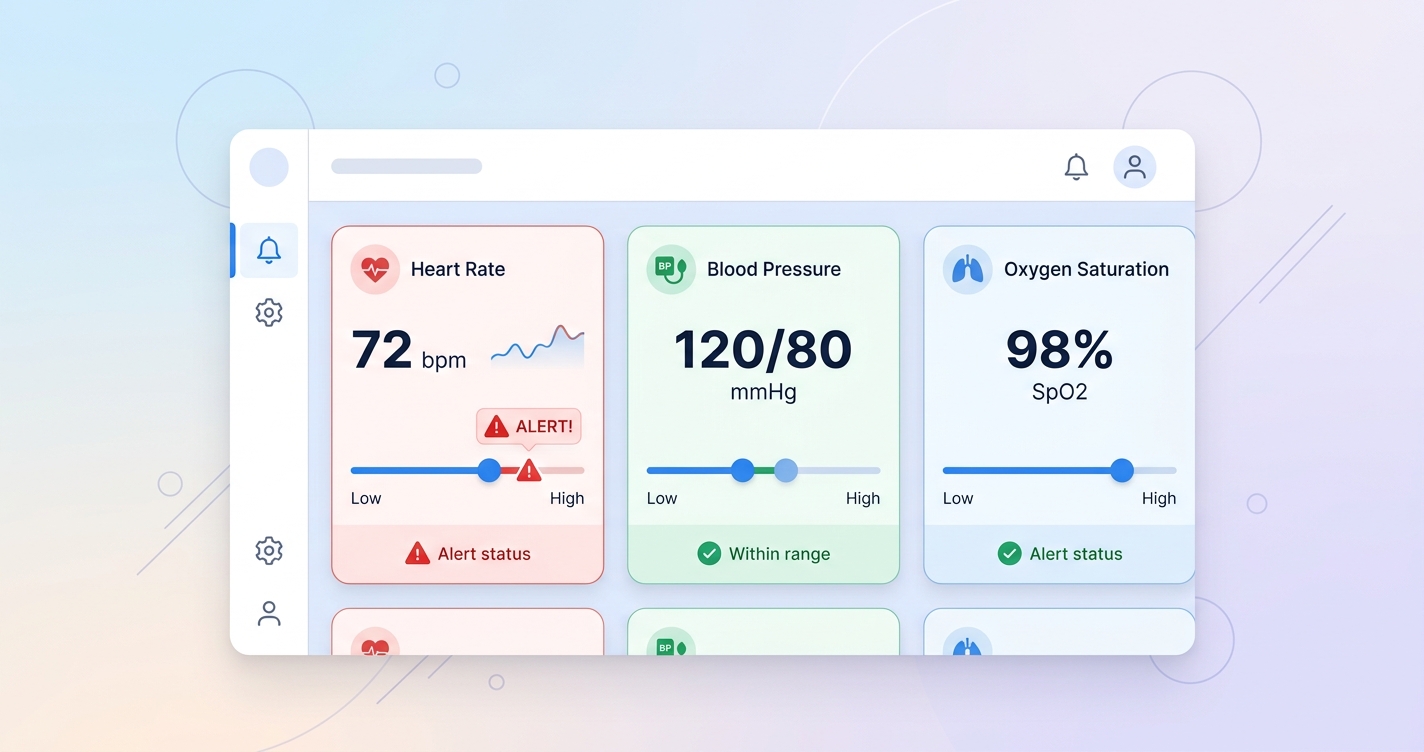
The phrase custom vitals thresholds alerts configuration sounds technical, but buyers usually feel it in a very practical way: too many alerts and the care team stops trusting the queue; thresholds that are too loose and early deterioration gets missed. For digital health founders, telehealth product managers, and hospital IT teams evaluating white-label monitoring platforms, the real question is not whether alerts exist. It is whether the platform can adapt thresholds, routing rules, and escalation logic to the population being monitored without turning every deployment into a custom software project.
"Guideline-based alert parameters in CIED patients significantly reduced [non-actionable alert] burden with no increase in adverse outcomes." — Mohamed A. Mostafa and colleagues, Journal of Cardiovascular Electrophysiology (2025)
Custom vitals thresholds alerts configuration: what teams are actually configuring
Most health platforms start with default thresholds for heart rate, respiratory rate, blood pressure, oxygen saturation, or temperature. That is the easy part. The harder part is deciding when those defaults should stay fixed, when they should be adjusted for a clinical program, and how alerts should be routed once a threshold is crossed.
In practice, teams are usually configuring four things at once:
- which physiologic measures trigger alerts
- what threshold or range counts as abnormal
- how long an abnormal reading must persist before the system escalates it
- who gets notified first, and what happens next
The Royal College of Physicians' NEWS2 framework is still useful as a baseline because it standardizes six common physiologic parameters: respiration rate, oxygen saturation, systolic blood pressure, pulse rate, temperature, and level of consciousness. But NEWS2 is a hospital early warning framework, not a universal template for every remote monitoring program. That distinction matters. White-label platforms are often deployed across different buyer environments, from virtual care programs to branded chronic care apps, and those environments do not all need the same thresholds or escalation paths.
| Configuration layer | What gets customized | Why it matters | Common risk if poorly configured |
|---|---|---|---|
| Clinical threshold | Upper/lower limits for BP, heart rate, SpO2, respiratory rate, temperature | Aligns alerts with the monitored population and protocol | Excess false positives or missed deterioration |
| Persistence rule | Single reading vs repeated abnormal readings over time | Filters noise from transient readings | Teams chase one-off outliers |
| Escalation path | Nurse queue, physician review, care manager, automated patient prompt | Determines response speed and workload | Important alerts land in the wrong queue |
| Tenant-level branding and workflow | Language, alert labels, role permissions, care pathway logic | Lets each customer run a branded program on shared infrastructure | Configuration drift across customers |
That table gets at the real design problem. Thresholds are only one part of the system. Configuration also includes timing, workflow, and accountability.
Why default thresholds break down in white-label deployments
A white-label platform may support a hypertension program, a post-discharge monitoring workflow, and a telehealth intake flow under different customer brands. If all three are forced to use the same alert logic, somebody eventually gets a dashboard full of noise.
Maria Cepeda, Patrick Pham, and Daichi Shimbo wrote in Hypertension Research in 2023 that ambulatory and home blood pressure monitoring are validated approaches for out-of-office measurement and that guidelines differ on when ABPM or HBPM should be used and what thresholds should guide diagnosis and management. That is a polite way of saying context matters. A monitoring threshold that is reasonable in one setting may not fit another one.
I keep coming back to this point because product teams sometimes treat configuration as a nice-to-have feature for enterprise accounts. It is not. It is basic clinical operations. If a platform cannot support customer-specific threshold logic, then the platform is really asking the customer to adapt its workflow to the software.
A more realistic model looks like this:
- use evidence-based baseline ranges as the starting point
- allow program-level overrides approved by clinical leadership
- separate informational alerts from escalation alerts
- tie alert routing to role and acuity, not just to the existence of an abnormal value
- audit every threshold change so the customer knows who changed what and when
That last part is easy to overlook. In a white-label environment, configuration itself becomes governed data.
Where smart alert configuration reduces noise
The strongest argument for custom thresholds is not elegance. It is workload control.
In 2025, Mohamed Mostafa and colleagues studied remote monitoring for cardiac implantable electronic devices and found that reprogramming alert parameters reduced non-actionable alerts from 6.68 to 2.27 without a statistically significant increase in stroke risk. The exact study population was device monitoring, not a general digital health app, but the operational lesson transfers well: when thresholds are tuned around clinical relevance, teams spend less time triaging noise.
Kyan Safavi and colleagues reported a related finding in Anesthesia & Analgesia in 2021. Their remote surveillance platform monitored 3,926 hospital visits, processed more than 1.56 million vital signs, generated 151 alerts, and averaged just 0.4 alerts per clinician shift. More important, 88.1% of accurate alerts were true positives associated with a clinical action. That is what buyers actually want from configuration. Not more alerts. Better alerts.
Here is the tradeoff in plain English:
- tighter thresholds can catch change sooner, but they can flood the queue
- looser thresholds reduce workload, but they can delay escalation
- persistence rules help, but only if the care pathway defines when repeated abnormalities matter
- the right setting depends on the population, staffing model, and response window
That is why good platforms rarely treat alerting as a flat on/off switch.
Industry applications
White-label RPM programs
For remote patient monitoring programs, the configuration question usually starts with enrollment criteria and nurse workload. A cardiometabolic program may want repeated elevated blood pressure to trigger outreach, while a post-discharge program may prioritize oxygen saturation or pulse trends in the first week after discharge.
Virtual care and telehealth platforms
Telehealth teams often use vitals capture to improve triage and documentation during virtual visits. In that setting, thresholds may be less about high-acuity escalation and more about directing patients to the right follow-up path. A branded white-label product has to support that without making every customer rebuild the decision logic.
Hospital and health system deployments
Hospital buyers usually care about governance first. They want standardized defaults, documented exception handling, role-based permissions, and clear escalation thresholds. NEWS2 remains influential here because it gives teams a common language for physiologic deterioration, even when remote workflows are customized around it.
Multi-tenant platform operations
This is the part software teams feel most directly. In a multi-tenant system, one customer may need conservative alerting, another may want wider ranges with repeated-reading confirmation, and a third may need tenant-specific escalation text for compliance review. That requires configuration architecture, not ad hoc edits.
Current research and evidence
The research base does not support a simplistic "one threshold fits all" approach.
The Royal College of Physicians' NEWS2 framework emphasizes standardized physiologic scoring for acute deterioration, but it also positions the score as a support for clinical judgment rather than a replacement for it. That matters because product teams sometimes confuse a standardized thresholding system with a complete workflow design. It is not the same thing.
Cepeda, Pham, and Shimbo's 2023 review on ambulatory and home blood pressure monitoring makes a similar point from another angle. Out-of-office monitoring is clinically useful, but thresholds have to be interpreted in the right setting, with attention to how readings are collected and what decision they are supposed to support.
Then there is the alert-fatigue evidence. Mostafa's 2025 study showed that guideline-based reprogramming reduced non-actionable cardiac-device alerts sharply. Safavi's 2021 ward surveillance study showed that remote alerts can stay highly actionable if the thresholds are severe enough and the routing logic is disciplined. Put those two together and the pattern is pretty clear: good alert systems are selective by design.
| Source | Key finding | Practical takeaway |
|---|---|---|
| Royal College of Physicians, NEWS2 | Uses six standardized physiologic parameters and threshold-trigger charts for acute deterioration | Standard defaults are useful, but they are only the starting point |
| Cepeda, Pham, Shimbo, 2023 | ABPM and HBPM are validated, with setting-specific thresholds and management implications | Out-of-office vitals need context-aware interpretation |
| Mostafa et al., 2025 | Non-actionable alerts fell from 6.68 to 2.27 after reprogramming device alerts | Threshold tuning can reduce noise without obvious safety loss |
| Safavi et al., 2021 | 88.1% of accurate alerts were true positives; average alert load was 0.4 per clinician shift | Good routing and severe-threshold design can keep alerts actionable |
The future of custom thresholds and alerts
The next phase is probably not endless manual rule-setting by each customer. It is more likely a layered model.
First, platforms will keep shipping evidence-based default thresholds so implementations do not start from a blank page. Second, customers will expect tenant-level configuration with approval workflows, audit trails, and role controls. Third, more systems will move toward trend-based logic rather than pure single-reading triggers.
That last shift is important. A one-time abnormal reading is often less meaningful than a worsening pattern across several readings. The challenge is building that logic in a way buyers can understand and govern. Black-box alerting may sound advanced, but clinical teams still need to know why a patient was escalated.
I doubt the winning platforms will be the ones with the most complicated rules engine. More likely, they will be the ones that make threshold logic visible, governable, and adaptable across many branded deployments.
Frequently asked questions
What does custom vitals thresholds alerts configuration mean?
It means setting program-specific rules for what counts as an abnormal reading, how persistent the abnormality must be, and who gets notified when the system decides escalation is needed.
Why are custom thresholds important in white-label health platforms?
Because different customers run different care models. A chronic care program, a telehealth workflow, and a hospital post-discharge program may all need different ranges, timing rules, and escalation paths even if they use the same core platform.
Do custom thresholds increase safety risk?
They can if they are changed casually. That is why most serious deployments use evidence-based defaults, clinical approval processes, audit trails, and clear escalation governance when thresholds are overridden.
How do teams reduce alert fatigue without missing deterioration?
Usually by combining clinically relevant thresholds with persistence rules, role-based routing, and separate handling for informational versus urgent alerts. The goal is not fewer alerts at any cost. It is a queue with a high proportion of actionable alerts.
If your team is evaluating how to configure branded monitoring workflows without turning each customer deployment into a separate product, solutions like Circadify Custom Builds are built for that middle ground.
Related reading on this site: How Hospital Systems Deploy White-Label Remote Monitoring, What Is Multi-Tenant Architecture? Health Monitoring Platforms Explained, and White-Label vs Build From Scratch: Cost and Timeline Compared.