
Can I check my oxygen level with my phone instead of a finger clip?
Learn how smartphone cameras estimate blood oxygen (SpO2) without a finger clip, the accuracy of the technology, and what it means for digital health apps.
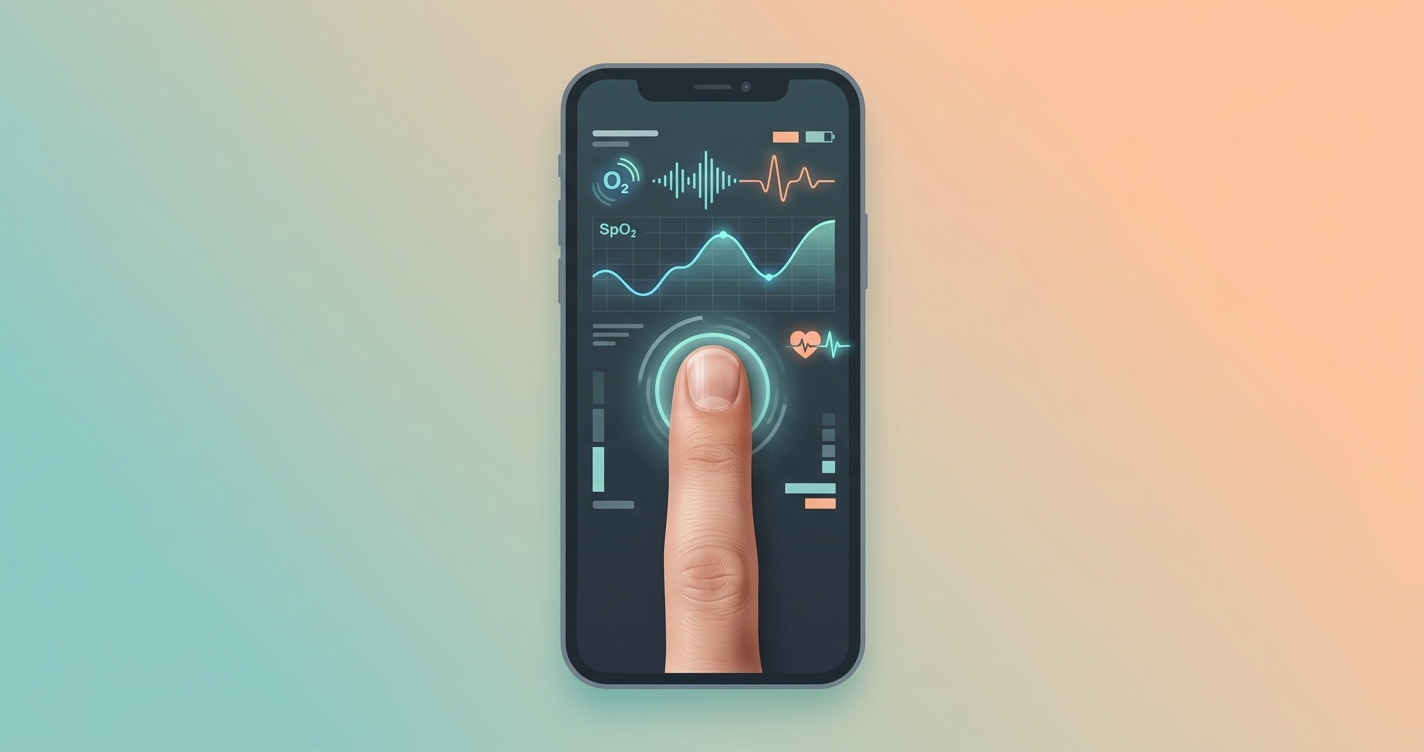
The demand for accessible, non-invasive health monitoring is surging. Consumers and patients alike are increasingly looking to the devices they already own, primarily smartphones, for insights into their well-being. This raises a critical question for digital health innovators and platform product managers: is it possible to check a user's oxygen level with their phone camera, eliminating the need for a traditional finger clip pulse oximeter? The answer is yes, and the technology behind it, remote photoplethysmography (rPPG), is rapidly maturing from a novelty into a viable tool for scalable health and wellness applications.
"In a study of 6 participants, we show that a smartphone can detect blood oxygen saturation (SpO2) levels down to 75%. We do so by obtaining a proof-of-concept for our non-invasive, deep-learning-based method, which achieves an average root-mean-square-error of 3.82% and a mean-absolute-error of 3.22%." - Researchers from the University of Washington and UC San Diego, npj Digital Medicine, 2022.
How camera-based oxygen monitoring works
The ability to measure an oxygen level phone camera no clip method relies on a technique called photoplethysmography (PPG). Traditional pulse oximeters that clip onto a fingertip use this principle. They emit red and infrared light through the skin and measure how much light is absorbed. The ratio of absorption of these two wavelengths by hemoglobin in the blood allows the device to calculate blood oxygen saturation (SpO2). Oxygenated hemoglobin absorbs more infrared light, while deoxygenated hemoglobin absorbs more red light.
Contactless, camera-based solutions adapt this principle for a smartphone. The process typically involves these steps:
- Light Source: The phone's LED flash illuminates the user's skin. While finger-based rPPG (placing a finger over the rear camera) is common, more advanced engines use the phone's screen to illuminate the user's face for a truly contactless reading.
- Sensor: The smartphone's camera acts as the sensor, recording a short video of the light reflecting off the skin.
- Signal Processing: As blood pulses through the vessels just beneath the skin, it causes minute changes in the color of the reflected light. These changes are invisible to the human eye but are captured by the camera.
- Algorithmic Analysis: Sophisticated algorithms, often powered by machine learning, analyze the video frames. They isolate the subtle color variations caused by blood flow and, by analyzing the differential absorption of light in the red, green, and blue channels of the video, can estimate the user's SpO2 level. The quality and training of these algorithms are what separate a novelty feature from a consistent and useful measurement.
| Feature | Traditional Pulse Oximetry (Finger Clip) | Camera-Based SpO2 Estimation (rPPG) |
|---|---|---|
| Mechanism | Transmissive PPG (light passes through finger) | Reflectance rPPG (light reflects off skin) |
| Hardware Required | Dedicated pulse oximeter device | Standard smartphone camera and light source |
| User Experience | Invasive; requires physical device contact | Contactless or minimal contact; software-only |
| Key Challenge | Device availability, user compliance | Motion artifacts, lighting variations, skin tone |
| Ideal Use Case | Clinical spot-checks, continuous hospital monitoring | Scalable remote wellness checks, telehealth intake |
Industry applications for camera-based SpO2
For digital health founders and telehealth product managers, integrating contactless vitals offers a significant competitive advantage by reducing user friction.
Telehealth and virtual care platforms
- Frictionless Intake: Patients can provide an SpO2 reading during a virtual waiting room session without needing any special hardware. This enriches the data available to the clinician before the consultation even begins.
- Longitudinal Monitoring: For chronic care management, asking users to perform a quick camera-based scan is far more scalable than shipping, managing, and troubleshooting dedicated hardware.
Digital health and wellness apps
- Enhanced Engagement: Offering users the ability to track their oxygen saturation can improve app "stickiness" and provide another valuable data point for wellness coaching, fitness tracking, and stress management applications.
- Feature Differentiation: In a crowded market, a scientifically-grounded oxygen level phone camera no clip feature can be a powerful differentiator that demonstrates a commitment to innovative, user-centric design.
Corporate wellness programs
- Scalable Screening: Enterprises can offer employees a way to monitor key wellness indicators without the logistical overhead of distributing and collecting devices.
- Data-Driven Initiatives: Aggregated, anonymized data can help wellness program managers identify trends and tailor interventions to better support employee health.
Current research and evidence
The scientific community has been actively investigating the accuracy and reliability of camera-based SpO2. A landmark 2022 study by a team of researchers from the University of Washington and the University of California, San Diego, including Edward Wang, Jason Hoffman, and Varun Viswanath, published in npj Digital Medicine demonstrated a significant step forward. Their deep-learning model was able to measure SpO2 levels down to 75% using an unmodified smartphone.
Their results showed the model could correctly classify individuals with low blood oxygen levels (<90%) with high sensitivity. This research is crucial because it validates the use of standard smartphone hardware, suggesting that the primary differentiator in performance is the quality of the underlying signal processing and machine learning engine. While not a replacement for medical-grade devices cleared by the FDA for diagnosing conditions like hypoxia, this level of performance is highly valuable for wellness and screening applications where the goal is to identify trends and flag potential issues for further review.
The future of contactless oxygen monitoring
The trajectory for this technology is pointed towards greater accuracy, robustness, and integration. Future advancements are expected in several key areas:
- Improved AI Models: Algorithms will become even better at filtering out "noise" from motion, variable lighting conditions, and different skin tones, leading to more reliable readings in real-world scenarios.
- Multi-Vitals Integration: SpO2 measurement will be seamlessly bundled with other contactless vitals like heart rate, heart rate variability, respiration rate, and even blood pressure estimation, providing a comprehensive wellness snapshot from a single, quick scan.
- Embedded Technology: The underlying software development kits (SDKs) will become easier to integrate, allowing digital health companies to add these capabilities to their apps with minimal engineering effort.
The question is shifting from if phones can measure oxygen levels to how well they can do it. For platform builders, the key is to look beyond the basic capability and evaluate the quality, reliability, and scalability of the engine powering the feature.
Frequently asked questions
Q: Is a phone oxygen reading as accurate as a medical device? A: Not yet. While research shows that high-quality camera-based systems can achieve impressive accuracy for wellness purposes, they are not intended to replace medical-grade pulse oximeters used for diagnosing and treating disease. They are best used for screening, wellness tracking, and identifying trends over time.
Q: What affects the accuracy of a camera-based oxygen reading? A: Several factors can influence accuracy, including significant user movement during the measurement, poor or inconsistent lighting, and the specific algorithms used by the application. High-quality engines use advanced signal processing and AI to mitigate these factors.
Q: Do I need a special app to measure my oxygen level with my phone? A: Yes. This capability is not native to smartphones. It requires a specific application that contains the rPPG signal processing and algorithmic engine to control the camera, capture the video feed, and analyze it to estimate oxygen levels.
The ability to check oxygen levels with a phone camera is no longer science fiction. It's a powerful new tool for any digital health company focused on delivering scalable, low-friction user experiences. Circadify is at the forefront of this technology, providing a robust, white-label engine that enables telehealth platforms, wellness apps, and enterprise providers to integrate contactless SpO2 and other vitals directly into their branded applications. If you're building a platform and want to add these capabilities without the R&D overhead, learn more about our solutions for custom builds at circadify.com/custom-builds.