
Camera-Based Vitals vs Wearables: Which Fits Your App?
A product team comparison of camera based vitals vs wearables on cost, accuracy, and user drop-off for health apps adding vital signs without hardware.
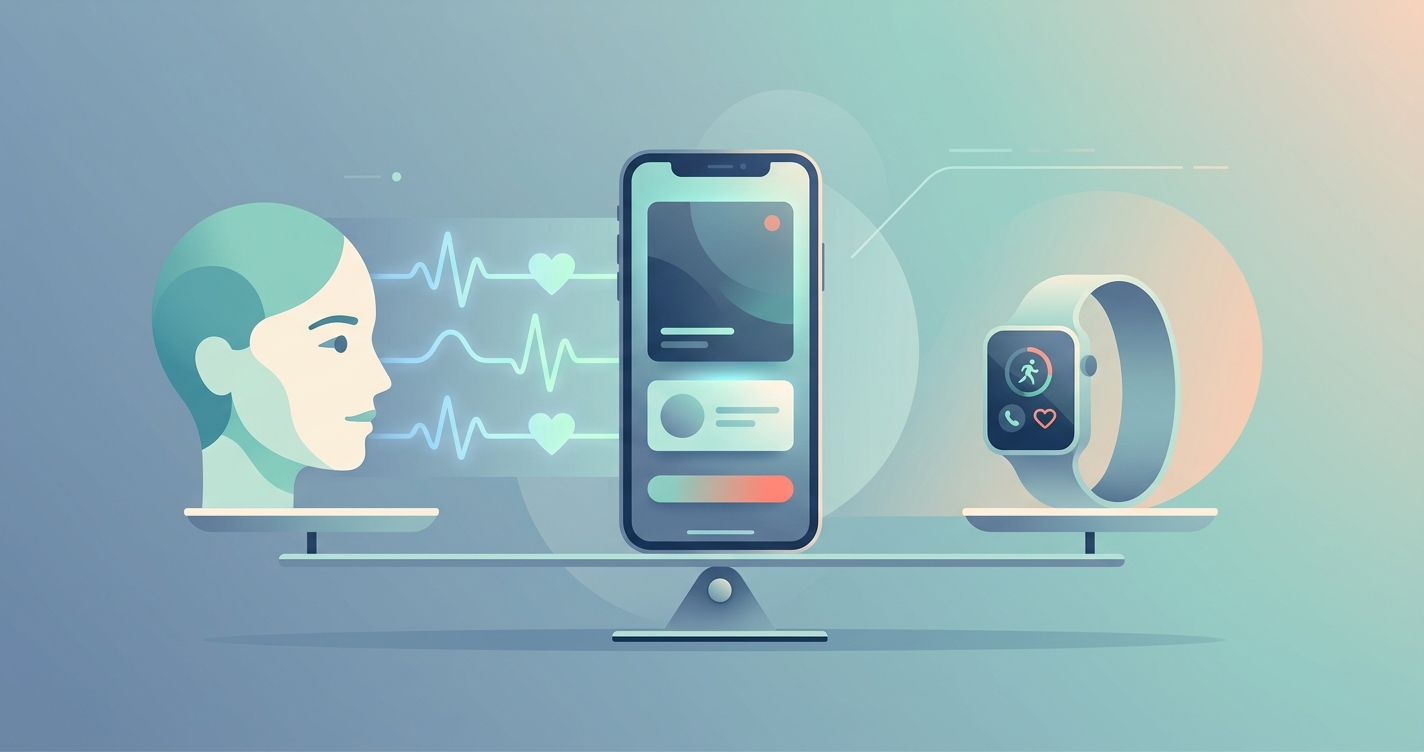
Product teams adding vital signs to a health app usually frame the decision as a sensor question, when it is really a distribution question. The choice between camera based vitals vs wearables decides who can use the feature on day one, how much the company spends per active user, and how many people abandon the flow before a reading completes. A wearable integration assumes the user already owns, charges, and wears a compatible device. A camera-based approach assumes only that the user has a smartphone with a front-facing camera, which describes nearly the entire addressable market. For telehealth platform PMs deciding how to extend their product, that gap in addressable population is the part of the analysis that gets underestimated.
A 2017 study by researchers at the University of Pittsburgh found that roughly one-third of wearable users abandoned their devices within six months, with about 30 percent of smartwatch owners and 29 percent of fitness tracker owners stopping use entirely.
Camera based vitals vs wearables: what actually differs
The core technical distinction is where the photoplethysmography signal is captured. A wearable reads blood-volume changes through a wrist or chest sensor pressed against the skin. Remote photoplethysmography, or rPPG, reads the same underlying signal from subtle color changes in facial skin recorded by a standard camera. Both infer heart rate and related metrics from the same physiological phenomenon, but the delivery model is completely different.
That difference cascades into product economics. A wearable strategy ties your feature roadmap to a third-party hardware ecosystem you do not control, including its SDK changes, firmware quirks, and pairing failures. A camera-based or no-device health monitoring approach keeps the measurement inside your own app, which means you own the user experience end to end. For teams evaluating a wearable alternative for health apps, the question is whether contactless accuracy is close enough to wearable accuracy for the intended use case, typically wellness, triage, or engagement rather than diagnosis.
The evidence suggests the accuracy gap has narrowed considerably for resting measurements. A 2025 validation study published in PMC reported 99.1 percent accuracy for heart rate using a non-contact rPPG mobile application under controlled conditions. A separate scoping review in Frontiers found good to very strong agreement between smartphone photoplethysmography and gold-standard electrocardiography for resting heart rate in healthy subjects.
| Factor | Camera-Based Vitals (rPPG) | Wearable Integration |
|---|---|---|
| Hardware cost to user | None, uses existing phone | Device purchase required |
| Addressable users on day one | Anyone with a smartphone | Only existing device owners |
| Onboarding friction | Open app, hold still 30-60s | Buy, charge, pair, sync |
| Drop-off risk | Single in-app flow | Up to ~30% abandon within 6 months |
| Accuracy at rest | Strong agreement with ECG in studies | Mean absolute error under 1 bpm vs ECG |
| Accuracy during motion or high HR | Declines at elevated heart rates | Affected by motion and sensor placement |
| Data ownership | Inside your app and brand | Shared with device ecosystem |
| Logistics | No shipping or inventory | Fulfillment, returns, support |
Where each approach wins
No single answer fits every product. The right choice depends on the clinical intent, the user population, and how the measurement fits into the broader workflow.
- Camera-based vitals fit best when reach and zero-friction onboarding matter more than continuous tracking, for example pre-visit telehealth check-ins, intake screening, or engagement nudges.
- Wearables fit best when continuous, passive, around-the-clock monitoring is the point, such as sleep staging, arrhythmia surveillance, or longitudinal trend capture.
- Camera-based approaches suit populations that will not buy or consistently wear a device, including older adults, low-income patients, and one-time or occasional users.
- Wearables suit motivated, already-equipped users who have opted into a fitness or chronic-care program.
- A hybrid model is increasingly common: contactless spot-checks for the broad population, with wearable data layered in for the subset that already owns devices.
Industry Applications
Telehealth Platforms
For telehealth, the operational pain is logistics. Shipping, charging, and supporting hardware adds cost and support tickets that scale linearly with users. App vitals without hardware remove that burden, letting a platform capture a heart rate or respiration reading during the patient's existing pre-appointment flow. The measurement happens in the same session the patient is already in, which protects completion rates.
Digital health startups
Early-stage teams face a build-versus-license decision under time pressure. A camera-based engine licensed as a white-label component lets a startup launch a differentiated vitals feature without managing a hardware supply chain or recruiting a signal-processing team. The contactless vitals comparison here is less about raw accuracy and more about speed to market and gross margin per user.
Hospital and health system IT
Hospital IT teams inherit an EHR, a patient portal, and a procurement process that resists new device fleets. A software-only vitals layer avoids new hardware budgets and the asset-tracking overhead that physical devices create across thousands of patients. The integration becomes a software project rather than a logistics program.
Current research and evidence
The research picture is nuanced rather than one-sided. On the wearable side, a validation study from Corsano Health found wrist and chest photoplethysmography sensors achieved mean absolute error under 1 beat per minute against ECG during sleep, though accuracy varied by body location, with forehead and chest outperforming wrist and ankle, and degraded with motion artifacts.
On the camera side, the same comprehensive review of rPPG and deep learning published in PMC noted that contactless methods perform well at rest but that accuracy can drop sharply at elevated heart rates, a known limitation for exercise or acute scenarios. News-Medical reported on research confirming this decline at high heart rates, which is why most credible vendors position contactless vitals for wellness and screening rather than diagnostic use.
The practical takeaway for product teams: both modalities are accurate enough for resting wellness measurements, both struggle under motion, and the deciding variables are usually reach, cost, and drop-off rather than a few beats per minute of error. The University of Pittsburgh abandonment data matters here, because a more accurate sensor that one-third of users stop wearing produces less usable data than a slightly noisier method that everyone can access on demand.
The future of camera based vitals vs wearables
The trajectory points toward convergence rather than a winner. Deep learning is steadily improving rPPG robustness across skin tones and lighting conditions, with at least one recent method reported to reach wearable-level accuracy for daily resting heart rate across all skin tones in uncontrolled settings. As that gap closes, the addressable-population advantage of camera-based capture becomes harder to ignore.
Expect three shifts over the next few product cycles. First, contactless will become the default for high-volume, low-friction touchpoints like intake and engagement, while wearables retain continuous-monitoring use cases. Second, regulatory and reimbursement frameworks will increasingly distinguish wellness measurement from diagnostic measurement, shaping which modality a team chooses for a given claim. Third, more platforms will adopt hybrid architectures that ingest both contactless spot-checks and wearable streams behind a single brand experience, treating the sensor as an implementation detail rather than the product itself.
Frequently asked questions
Is camera-based vitals accurate enough to replace wearables?
For resting heart rate and wellness screening, published studies show strong agreement between camera-based rPPG and ECG, comparable to wearable performance. Both modalities lose accuracy during motion and at elevated heart rates, so neither is positioned as a diagnostic replacement without appropriate validation. The choice depends on use case rather than raw accuracy alone.
Which option has lower user drop-off?
Camera-based capture generally has lower structural drop-off because there is no device to buy, charge, or pair. Wearable adoption studies have found roughly one-third of users abandon devices within six months, which removes them from any data pipeline that depends on the device being worn.
When does a wearable integration still make sense?
When the product requires continuous, passive, 24/7 data such as sleep tracking or long-term arrhythmia surveillance, wearables remain the better fit. Many teams use a hybrid model: camera-based spot-checks for the full population and wearable streams for the subset that already owns compatible devices.
Can we add camera-based vitals without building the engine ourselves?
Yes. White-label rPPG platforms let product teams embed contactless vitals under their own brand without developing signal-processing infrastructure or managing hardware. This shortens time to market and keeps the measurement inside the team's own app and data environment.
Circadify is building in exactly this space, supplying a fully white-labeled contactless vitals engine so telehealth and digital health teams can add app vitals without hardware under their own brand. Teams weighing camera based vitals vs wearables for an upcoming release can explore a white-label vitals demo and discuss a custom build at circadify.com/custom-builds.