
Best White-Label Vitals Platforms for Senior Care Apps
A ranked buyer's guide to white label vitals for senior care apps, weighing alerts, ease of use, and OEM fit for aging-in-place and caregiver products.
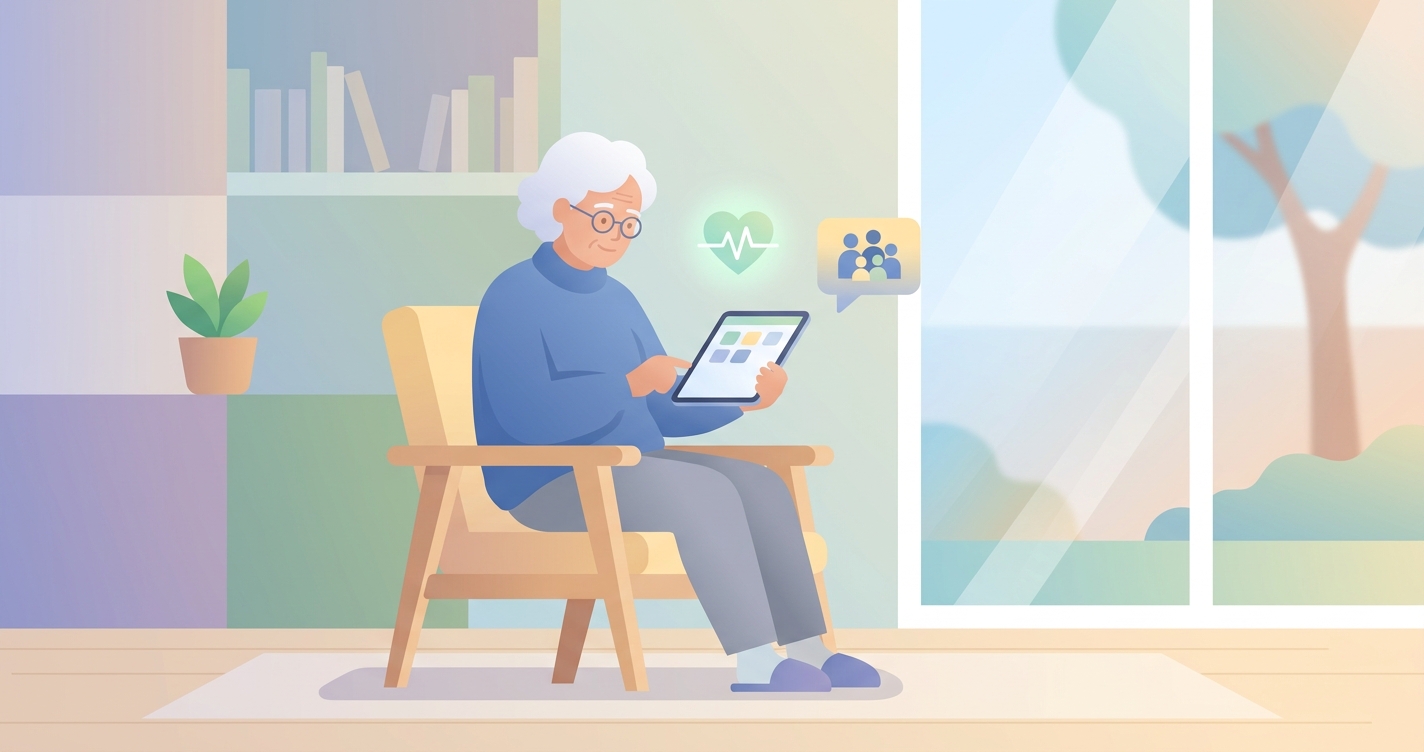
Founders building for aging-in-place rarely fail on clinical ambition. They fail on the unglamorous middle layer: how a vital sign gets captured by an 82-year-old, turned into a trend, and pushed to a worried adult child before anything goes wrong. Choosing white label vitals for senior care is really a decision about that middle layer, and most teams underestimate how much of their roadmap it will consume. The hardware-free, branded approach has matured enough that buying the engine and keeping the brand is now the default for serious senior-care apps, not a shortcut.
The global remote patient monitoring market reached an estimated $48.51 billion in 2025, and roughly two-thirds of seniors say they want to age in place at home, according to market analyses compiled by IMARC Group and Fact.MR (2025).
That gap between where care happens and where seniors want to be is the entire commercial opening. Below is how to evaluate the platforms that fill it.
What "white label vitals for senior care" actually means
When buyers shop for white label vitals for senior care, they are usually combining three things that vendors price separately: a measurement engine, an alerting and threshold system, and an OEM packaging layer that lets the app ship under your name. A platform can be excellent at one and weak at the others. A senior health platform OEM that nails camera-based heart rate but offers no caregiver alert routing will leave you building the most important feature yourself.
For aging-care products specifically, the evaluation criteria shift away from raw feature counts toward three things older users and their families actually feel:
- Capture friction. Can a senior complete a reading unassisted, in poor lighting, without a wearable to charge?
- Alert intelligence. Does the system distinguish a meaningful change from noise, or does it bury caregivers in false alarms?
- Family visibility. Can an adult child or care coordinator see trends and get notified, not just the patient?
A 2024 scoping review in aged care, indexed on PubMed, found that wearable adherence among older adults remains a persistent obstacle because of discomfort, charging, and the stigma of "patient" devices. That single finding pushes many senior-care founders toward contactless, camera-based capture as the lower-friction path.
Ranking the white-label options for aging care
The table below compares the platform categories a senior-care founder will encounter, ranked by fit for aging-in-place and family caregiver monitoring tech use cases. Rankings reflect typical tradeoffs, not any single named vendor.
| Rank | Platform type | Capture friction for seniors | Alert + family routing | OEM / branding depth | Best fit |
|---|---|---|---|---|---|
| 1 | Contactless rPPG vitals engine (white label) | Very low - phone or tablet camera, no device to wear | Configurable thresholds, caregiver push | Full white label, your brand | Aging-in-place and caregiver apps |
| 2 | Wearable-based RPM SDK | Medium - charging and daily wear required | Strong continuous alerts | Partial; hardware often co-branded | Chronic-condition managed care |
| 3 | Bluetooth peripheral kits (cuffs, oximeters) | High - multiple devices, setup help needed | Good but device-dependent | Limited; hardware carries vendor mark | Clinical RPM reimbursement programs |
| 4 | General telehealth SDK with add-on vitals | Medium - varies by module | Basic, often manual | Moderate | Video-first virtual care |
| 5 | Build in-house from open libraries | Unpredictable | Whatever you build | Total control, total cost | Well-funded teams with ML staff |
The pattern is consistent: contactless capture wins on the friction dimension that matters most for seniors, while traditional RPM kits win where billing codes and clinical-grade peripherals are mandatory. For a branded health app for aging care that lives on a phone or a bedside tablet, the camera-based route removes the logistics burden of shipping, replacing, and supporting hardware across a frail population.
Industry Applications
Aging-in-place and independent living
The largest opportunity is the senior who lives alone and wants to stay that way. Here, remote monitoring for elderly apps succeeds when a daily reading becomes a habit rather than a chore. A contactless check that takes thirty seconds on a tablet propped in the kitchen outperforms a cuff that sits in a drawer. The platform's job is to capture quietly, trend silently, and only surface something when a pattern deviates.
Family caregiver coordination
Adult children are the real economic buyers in much of this market, even when the senior is the user. Family caregiver monitoring tech turns scattered phone calls into a shared dashboard. The differentiator is not the vital sign itself but the routing logic: who gets notified, how fast, and with what context. Platforms that let you define escalation tiers, for example notify the daughter first and the care agency second, map to how families actually operate.
Senior living operators and home health agencies
Operators deploying across dozens of residents need a senior health platform OEM that scales administratively. That means bulk onboarding, role-based access for staff, and alert thresholds set per resident rather than globally. The branding layer matters here too, because operators want the app to carry their facility's name, reinforcing their relationship with families rather than a third-party vendor's.
Current research and evidence
The scientific case for contactless capture in senior care has strengthened. A 2024 systematic review of non-contact vision-based vital sign monitoring published in MDPI's Sensors concluded that remote photoplethysmography can measure heart rate and respiratory rate without contact, while noting that accuracy is still affected by motion, lighting, and skin tone, all of which remain active areas of refinement. For senior-care buyers, that nuance is the due-diligence checklist: ask any vendor how their engine performs in dim rooms and with limited user movement, because those are the real conditions of an older adult's home.
Parallel work on fall detection shows where the category is heading. Researchers publishing in 2024 on next-generation fall detection (PubMed) demonstrated privacy-preserving, non-wearable systems using human pose estimation and transformer models, and a separate MDPI study paired YOLO-based computer vision with voice interaction to cut false alarms. The throughline is that camera-and-AI approaches are converging on the same promise: monitor seniors without asking them to wear or carry anything.
On the demand side, AARP's ongoing technology-for-aging research has documented growing interest among older adults in tools that support independent living, and analysts at Fact.MR put the U.S. senior tech services market near $1.09 billion for 2025. The market is large enough to support specialized white-label infrastructure, which is precisely why building the engine from scratch is rarely the rational choice.
The future of white-label vitals for senior care
Three shifts are worth planning around. First, expect alerting to become the primary product surface. As capture commoditizes, the value migrates to how intelligently a platform separates signal from noise, a problem that compounds with frail populations who naturally show more day-to-day variability. Second, family-facing experiences will get first-class treatment rather than being bolted on, because caregivers are the retention engine. Third, contactless and ambient methods, including the fall-detection research above, will increasingly bundle with vitals into a single passive monitoring layer, reducing what the senior has to do to nearly zero.
For founders, the strategic implication is that owning the brand and the clinical workflow while licensing the engine gives you the best position. You control the relationship with families and operators, you avoid hardware logistics, and you inherit the vendor's ongoing model improvements without staffing a computer-vision team.
Frequently asked questions
What is the difference between a white-label vitals engine and a full RPM platform?
A white-label vitals engine provides the measurement and branding layer that you embed in your own app. A full RPM platform often bundles hardware, billing, and a vendor-controlled interface. For senior-care founders who want their own brand and low-friction capture, the engine-plus-OEM model usually offers more control and lower operational overhead.
Are camera-based vitals reliable enough for elderly users?
Peer-reviewed reviews, including a 2024 MDPI systematic review, confirm that contactless rPPG can measure heart rate and respiratory rate, while flagging that lighting, motion, and skin tone affect accuracy. For senior care, the practical step is to test any platform under realistic home conditions and to treat readings as trend data within a broader monitoring workflow rather than as standalone diagnostics.
How important are alerts and family notifications in senior-care apps?
They are often the deciding feature. Adult children and care coordinators are frequently the economic buyers, and a platform's ability to route the right alert to the right person with context is what drives retention. Evaluate threshold customization and escalation tiers as closely as you evaluate the measurement itself.
Can I launch a branded senior-care app without building the vitals technology myself?
Yes. A senior health platform OEM model lets you ship contactless vitals under your own brand while the underlying engine is maintained by the vendor. This avoids the cost of an in-house computer-vision team and removes hardware shipping and support from your operations.
Circadify is addressing this space directly, with a fully white-labeled contactless vitals engine designed to sit behind your brand and your senior-care workflow. If you are building an aging-in-place or family caregiver product and want to see how branded, hardware-free vitals fit your roadmap, book a partnership conversation at circadify.com/custom-builds.