
7 Integration Points When Connecting a White-Label Platform to Your EHR
A research-backed analysis of white label health platform EHR integration, covering seven connection points that shape workflow, data quality, and scale in 2026.
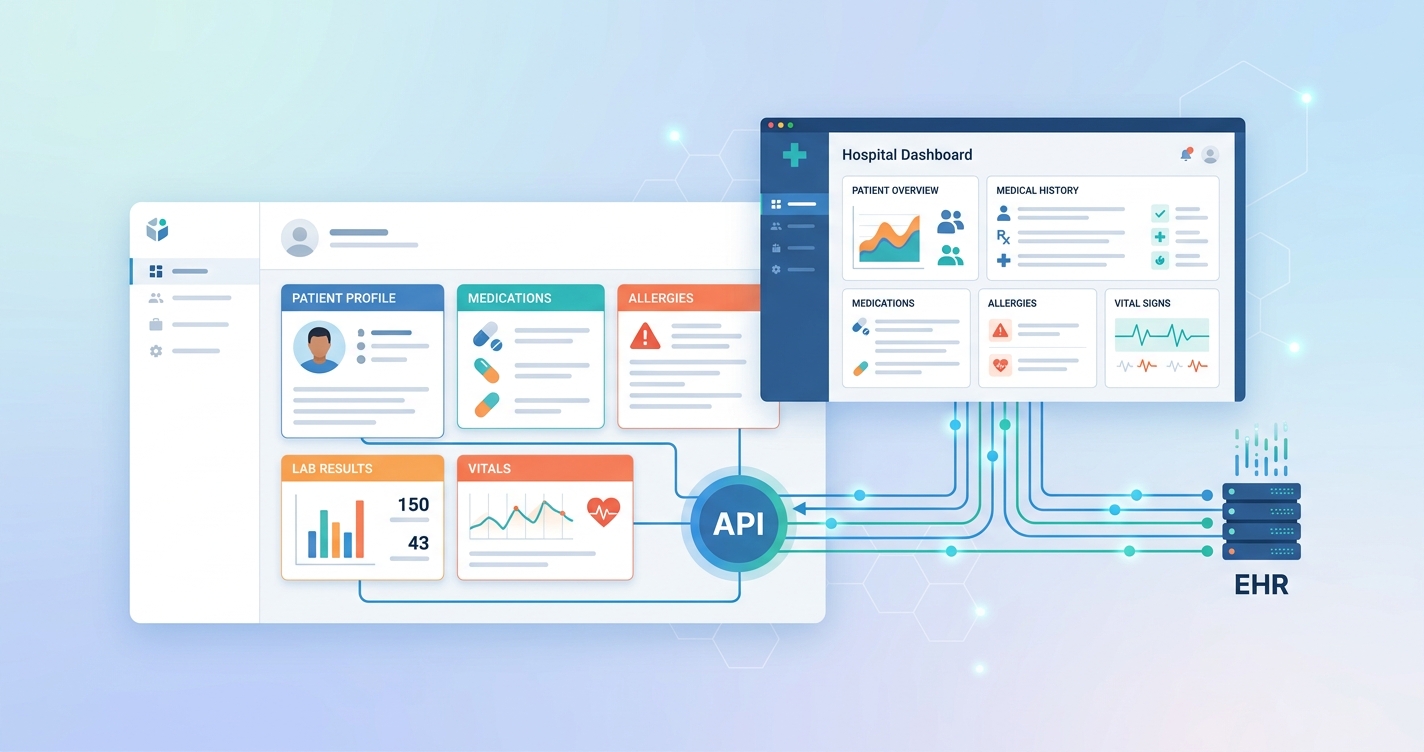
White label health platform EHR integration usually gets discussed as if it were a single interface project. It rarely is. By the time a digital health company, telehealth platform, or hospital IT team gets serious about deployment, the real work sits across identity, patient matching, orders, observations, alerts, documents, and reporting. The interface engine matters, but the bigger question is whether the platform can fit the operational shape of the health system without creating one more brittle data silo.
"The shift to FHIR enables secure and efficient access to patient data through modern APIs." — Julia Adler-Milstein, UCSF, on U.S. interoperability progress and friction in hospital exchange research
White label health platform EHR integration starts with seven connection points
Most teams talk about EHR integration in broad terms. Procurement and implementation teams do not. They break it into specific handoffs. That is a healthier way to look at the work, especially with the ONC HTI-1 final rule pushing certified health IT toward USCDI v3 support by January 1, 2026 and updated API expectations built around HL7 FHIR US Core 6.1.0 and SMART App Launch 2.0.
The seven integration points below are the ones that tend to decide whether a branded platform feels operationally usable or permanently half-attached.
| Integration point | What moves between systems | Why it matters | Common failure mode |
|---|---|---|---|
| Patient identity and matching | MRN, demographics, identifiers | Prevents duplicate charts and routing errors | Weak matching logic creates manual cleanup |
| Scheduling and encounter context | Appointments, visit IDs, provider context | Ties data to the right workflow and billing context | Scans arrive without encounter linkage |
| Orders and questionnaires | Screening requests, intake tasks, consent steps | Starts the workflow in a controlled way | Staff rely on email or spreadsheets instead |
| Vital signs and observations | Heart rate, respiratory rate, SpO2, BP, metadata | Makes data clinically and analytically usable | Values land as PDFs or free text |
| Alerts and inbox routing | Threshold events, exceptions, escalation tasks | Connects measurements to action | Notifications live outside the EHR queue |
| Documents and longitudinal summaries | Visit summaries, trend reports, attachments | Supports review across time | Clinicians see fragmented history |
| Analytics and population reporting | Program metrics, completion, quality signals | Helps operators manage scale | No reliable view across sites or tenants |
That table sounds simple, but simplicity is the point. Integration projects usually become painful when teams skip one of these layers and then discover six weeks later that the data technically arrived but cannot be used.
1) Patient identity and matching
This is the least glamorous integration point and maybe the most important. If the white-label platform cannot reconcile patients against the health system's identifiers, everything downstream gets shaky.
Julia Adler-Milstein and colleagues have written for years about the gap between nominal interoperability and usable exchange. Their work on hospital interoperability indexes shows that friction often sits in the details: data quality, workflow fit, and the practical effort required to exchange information. Patient matching is one of those details. A platform may have a modern API and still fail operationally if duplicate or mismatched identities force manual review.
Teams usually want:
- support for MRN plus external platform identifiers
- demographic matching rules with clear confidence thresholds
- audit trails for identity resolution
- a fallback process when a confident match cannot be made
2) Scheduling and encounter context
A measurement without visit context is often less useful than vendors expect. Hospital IT teams usually want to know whether the scan belongs to a telehealth visit, a screening workflow, a chronic care touchpoint, or a pre-visit intake event.
This matters because the EHR is not just a record store. It is also the workflow spine. If data shows up detached from encounters, it can miss provider inboxes, downstream documentation, and billing-related review steps. That is why scheduling APIs, encounter IDs, and provider context become integration points of their own rather than optional metadata.
A realistic integration package usually includes:
- appointment lookup or encounter creation logic
- provider and department context
- timestamps normalized to the health system record
- status updates when the scan is completed or abandoned
3) Orders, intake, and questionnaire handoff
A lot of branded platforms begin as patient-facing experiences, but enterprise deployments usually need a formal trigger. That might be a digital intake task, a standing screening order, or a questionnaire sequence that determines whether vitals collection should start.
This is where interoperability moves beyond a one-way feed. The platform has to receive workflow intent from the EHR and return completion status in a way staff can trust. If that handoff is missing, operations teams tend to create side workflows in email, spreadsheets, or separate dashboards. Once that happens, the integration stops feeling like infrastructure.
4) Vital signs as structured observations
This is the integration point everyone expects, but not everyone implements well. Under USCDI v3, vital signs remain a recognized data class, and the HL7 FHIR Observation resource gives health systems a standard path for structured exchange. In practice, buyers want more than a values dump. They want timestamps, device or method context when appropriate, units, and enough structure for downstream review.
The old failure mode is still common: measurements arrive as PDFs, screenshots, or note text. That preserves evidence, but it does not create reusable clinical data.
What better implementations try to preserve:
- a structured Observation format rather than document-only output
- units and coding aligned to the target system
- collection timestamp and source context
- flags for incomplete or low-confidence captures when workflow requires review
5) Alerts and inbox routing
Data that never reaches a queue is not really integrated. This is one reason remote monitoring teams keep pushing harder on alert routing rather than pure measurement capture.
Recent monitoring literature makes the operational point clearly. Researchers including Kyan Safavi and colleagues showed that remote surveillance can stay actionable when thresholds and routing are selective instead of noisy. That lesson applies here. If abnormal values trigger alerts only inside the white-label platform, the EHR remains blind at the moment when teams need a documented response path.
For hospital and telehealth buyers, the real question is where the task lands:
- nurse inbox
- virtual care queue
- physician review list
- patient follow-up workflow
Without that mapping, the integration is informative but not operational.
6) Documents and longitudinal summaries
Not every stakeholder wants raw observations first. Program managers, clinicians, and compliance reviewers often want a readable summary over time. That is why documents still matter even in a FHIR-first environment.
The strongest deployments usually combine both layers: structured observations for computable workflow and a longitudinal summary for quick human review. The document might capture trend context, missing sessions, escalation history, or summary notes that are harder to understand from isolated observations alone.
I think this is where many platform teams underestimate clinicians. They do want clean data. They also want a quick way to understand the story around the data.
7) Analytics and population reporting
The final integration point sits above the patient chart. Once a platform is live across sites, programs, or customer tenants, operators need reporting. CHIME's 2025 Digital Health Most Wired findings keep pointing back to the same thing: digital maturity now depends on governance, analytics, and usable interoperability, not just feature adoption.
That has consequences for white-label architecture. Health systems and digital health operators often ask for program-level feeds that can answer:
- how many patients completed screening
- where drop-off is happening
- which sites generate the most exceptions
- whether alerts are actionable or mostly noise
- how branded programs compare across business units
If the EHR integration stops at patient-level data exchange, the organization still lacks the management layer needed to scale the program.
Industry applications
Telehealth platforms
Telehealth teams usually care most about encounter context, structured observations, and routing back into follow-up queues. The measurement only matters if it changes the virtual visit workflow.
Hospital and health-system deployments
Hospitals tend to press harder on identity resolution, governance, and document retention. They also tend to notice quickly when a vendor confuses data delivery with workflow integration.
Multi-tenant white-label programs
For organizations running several branded programs, analytics and tenant-level reporting become just as important as patient chart integration. Otherwise every customer rollout becomes another operational blind spot.
Current research and evidence
The evidence around health IT interoperability has gotten less idealistic and more practical. Adler-Milstein's work at UCSF focuses on whether exchange is actually usable inside hospitals, not just whether a connection exists. ONC's HTI-1 final rule pushes the regulatory baseline higher, especially around API-enabled access and USCDI v3. HL7's FHIR framework remains the technical center of gravity for structured exchange, while SMART on FHIR gives platforms a cleaner way to launch into EHR context and manage authorized access.
The lesson across all of these sources is not that every integration must look identical. It is that health systems increasingly expect modular integration points rather than vague promises of interoperability.
| Source | Key finding | What it means for integration planning |
|---|---|---|
| ONC HTI-1 Final Rule / HealthIT.gov | USCDI v3 becomes the baseline for certified health IT on January 1, 2026, with updated API requirements | Buyers expect modern, standards-based exchange paths |
| USCDI v3 / HealthIT.gov | Vital Signs remains a defined interoperable data class | Structured vitals exchange matters more than document-only output |
| Julia Adler-Milstein and colleagues, UCSF / hospital interoperability research | Interoperability friction often persists even when connections exist | Workflow fit and data usability matter as much as transport |
| CHIME Digital Health Most Wired 2025 | Governance, analytics, cybersecurity, and interoperability define digital maturity | Reporting and operational visibility belong in the integration plan |
| HL7 FHIR and SMART App Launch guidance | Modern APIs support contextual access and standardized data exchange | Identity, launch context, and observation structure should be designed together |
The future of white-label platform EHR integration
The next phase probably looks less like one giant interface and more like a governed integration stack. FHIR will keep expanding the standard pathway, but hospitals and digital health buyers will still judge vendors on workflow fit, not standards vocabulary alone.
That means better integration packages will likely emphasize:
- prebuilt support for identity and encounter context
- structured observations plus readable summaries
- alert routing into existing work queues
- tenant-aware analytics for operators
- clearer implementation boundaries so projects do not turn into endless custom work
In other words, the market is moving from "Can it connect?" to "Can it connect in the places that actually matter?"
Frequently asked questions
What does white label health platform EHR integration usually include?
At a minimum, teams usually evaluate patient matching, encounter context, structured observations, alert routing, and reporting. More mature deployments also include order triggers and longitudinal summaries.
Why is FHIR important for EHR integration?
FHIR gives health systems and vendors a standard way to exchange structured health data through modern APIs. It is especially important when teams want measurements to be reusable in workflows rather than stored as documents alone.
Is sending a PDF report into the chart enough?
Usually not. A PDF can help with review, but it does not replace structured observations, routing logic, and encounter-linked workflow.
What breaks most EHR integrations in practice?
The common failures are poor patient matching, missing visit context, unstructured data, and alerts that never enter the health system's working queues.
If your team is mapping a branded health product to existing clinical systems, solutions like Circadify Custom Builds are aimed at organizations that need white-label flexibility with standards-based integration planning.
Related reading on this site: How to Set Up Role-Based Access Control on a White-Label Health Platform, What Is Multi-Tenant Architecture? Health Monitoring Platforms Explained, and White-Label Health Platform Compliance: HIPAA, SOC 2, Data Residency.